
Balance Training for Everyday Sports: From Single‑Leg Control to Everyday Movement Confidence
Whether you’re playing pickup games, jogging in the park, or carrying groceries up the stairs, every step depends on how steadily you control your body. Training the systems that keep you upright can sharpen control, protect joints, and make everyday movement feel easier and more secure.
This story is part of DailySeekers's practical reading library across everyday topics.
Why Steady Control Matters More Than Raw Strength
Steady control sounds less exciting than big numbers on a barbell, but it shapes how everyday sports feel. When your body stays organised as you speed up, slow down, twist, or land, movements look smoother and feel safer. Raw strength is useful, yet without control it can be hard to use during real situations, such as changing direction in a casual game or catching yourself after a stumble.
Control starts with simple building blocks. The feet sense the ground, the core keeps the middle of the body steady, and the hips react quickly. This is why basic drills, single‑leg work, and slow, controlled movements matter. They teach muscles to coordinate rather than just push hard. Instead of thinking only about how much force you can produce, it helps to think about how well you can guide that force.
Good control is not just standing on one leg without moving. It is a mix of strength, mobility, and timing. Strong muscles support the joints, flexible hips and ankles let you adjust position, and quick reactions help you stay upright when something unexpected happens, such as a ball taking a strange bounce or a slippery patch on a path.
Exercises that work one side at a time, such as step‑ups or single‑arm carries, are especially helpful. They reveal side‑to‑side differences and ask the core to stabilise while one side moves. Over time, this supports running, jumping, and turning so they feel more controlled and less tiring.
| Focus area | What it mainly supports | Simple example choice |
|---|---|---|
| Foot and ankle control | Staying stable on uneven ground | Barefoot balance on a firm surface |
| Hip and core strength | Keeping knees and spine aligned during direction changes | Slow step‑ups or step‑downs |
| Reaction and timing | Recovering after trips, bumps, or sudden stops | Light marching with posture reset |
From Two Feet to One: Progressions You Can Trust
Start with a solid two‑foot base
Before standing on one leg, it helps to feel steady on two feet. Stand tall with feet about hip‑width apart and “root” your whole foot into the floor, from heel to toes. Gently engage your core, soften your knees, and fix your eyes on something that is not moving.
From here, add small challenges while keeping both feet down. Shift your weight a little to the left, then to the right; rock forward toward your toes, then back toward your heels; or practice a slow mini‑squat. If your posture collapses or you feel unsteady, reset to a simpler version.
Gradually, this teaches your body where your comfortable range ends and how to react before you drift too far. Many people notice their feet and lower legs working harder in these simple drills.
Move from one foot to real‑life tasks
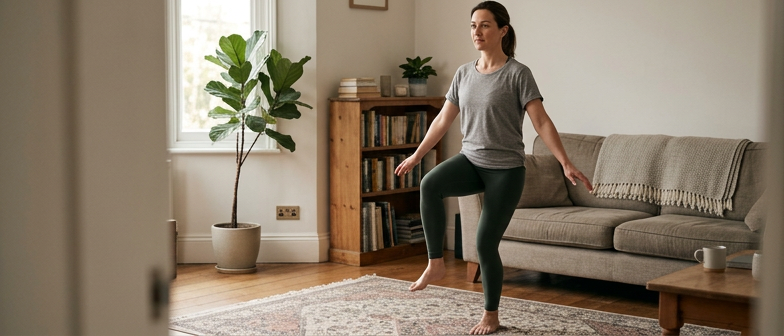
When two‑foot work feels stable, lift one foot just a few centimetres off the ground. Lightly hold a stable object with one hand to begin. As your confidence grows, reduce the hand support or add gentle challenges, such as turning your head slowly side to side or moving your free leg in a small circle.
Next, add everyday tasks. Stand on one leg while brushing your teeth or putting on a sock. Later, stay balanced while tying your laces. Each step changes only one thing at a time: less hand support, a little more movement, or a longer hold.
For people already active in casual sports, single‑leg deadlifts, step‑downs, or slow walking lunges can form the next layer. Keep the tempo controlled and the range of motion small at first. The goal is to let your body learn to stay steady instead of rushing through the motion. When a drill feels smooth and almost boring, that is often a good moment to nudge the challenge slightly.
Stacking Real‑World Challenges Without Extra Wobble
Linking walking, reaching, and turning
Walking, reaching, and turning rarely happen alone. In everyday play you might walk, twist to catch a pass, reach overhead, then turn again. Good control lets you connect all of that without the knees knocking or the torso swaying from side to side.
A practical way to train this is to start from a steady base, then add small layers. Think of your feet as your base of support and your belly, hips, and ribs as the centre that should stay roughly above that base.
Heel‑to‑toe walks along an imaginary line already demand this coordination. Each step narrows your base, so the hips and ankles must make fine adjustments. Once this feels manageable, add a gentle reach forward with one arm, then a slow head turn to the side while you keep walking.
Practical drills: from simple to slightly spicy
Marching in place with opposite arm reaches is an approachable starting drill. Lift one knee, reach forward or slightly overhead with the opposite hand, pause for a moment, then switch sides. Try to keep your ribs stacked over your hips rather than leaning backwards or arching the lower back.
Side‑stepping and lateral step‑overs add the sideways and rotational elements that many people miss. Step to the side, sit slightly into the outside hip, and keep the toes mostly pointing forward. For an extra challenge, slowly turn your head to look over one shoulder while your feet keep moving.
Practiced a few times a week, these small, organised challenges can build calm confidence. Movements in everyday sports often start to feel smoother, with fewer stumbles and a greater sense that your feet and hips know how to respond.
| Drill type | Extra element it adds | When it may help most |
|---|---|---|
| Narrow‑stance walking | Smaller base of support | Games with quick stops and starts |
| Side‑stepping | Lateral hip and knee control | Activities with shuffling or sideways movement |
| March with reach | Arm–leg coordination and timing | Light running, casual racquet or ball games |
A Short Daily Routine That Actually Fits Your Life
Start tiny with 10–15 focused minutes
A steadier body in everyday sports usually grows from small, regular practice rather than demanding workouts. One helpful approach is to choose a daily 10–15‑minute block you can realistically keep.
A simple structure might look like this:
- Warm‑up: a minute or two of easy marching in place and gentle arm circles
- Core and hips: clamshells on each side, then a bear plank‑style hold
- Single‑leg work: one‑leg stands or a tree‑pose‑style stance, plus a controlled reach in front or to the side
Most people do well with a few sets of slow repetitions or short holds. The priority is calm, precise movement rather than fatigue. If a position creates sharp discomfort, reduce the range, add support from a wall or chair, or choose a nearby variation.
Match your routine to the games you enjoy
Once the basics feel comfortable, you can shape your mini‑routine around the activities you like most, without making it complicated. People who jog or cycle casually often benefit from drills such as single‑leg hip hinges, lateral step‑throughs, and side leg lifts to help keep hips and knees aligned. Anyone who plays informal change‑of‑direction sports can add reverse lunges, lateral reaches, and controlled step‑ups to echo the way they cut, pivot, or move toward a ball.
Progress does not always need added equipment. You can slow down the lowering phase of a movement, pause briefly at the hardest point, or, if it feels safe, close your eyes during simple single‑leg stances to change how your body relies on its senses. Throughout, keep your posture tall, with ribs stacked over hips, and let your breath stay smooth.
When this kind of short routine becomes part of most days, it can support steadier landings, cleaner footwork, and a growing sense of trust in how your body moves, so everyday sports become less about worrying whether you might trip or twist something and more about enjoying the freedom to move with control.
Q&A
-
How does Balance Training For Everyday Sports differ from traditional gym workouts?
Balance training for everyday sports focuses on how well you manage your body in motion, not just how much weight you lift. It integrates posture, joint alignment, and reaction speed in tasks that look like real life, such as cutting, decelerating, or landing, so your strength actually transfers to informal games and daily activities. -
Why is Single Leg Control so crucial for casual runners and weekend athletes?
Single leg control underpins every stride, jump, and change of direction, because you spend most dynamic movements supported by one leg at a time. Training it exposes asymmetries, sharpens hip and foot stability, and reduces “knee collapse,” which can lower injury risk and make your running or cutting feel lighter and more efficient. -
What Stability Exercise Ideas are best for building Fall Prevention Benefits at home?
Effective home stability work can stay simple: narrow‑stance walks along a hallway, controlled step‑downs to a low step, or standing on one leg while reaching in different directions. These drills blend strength, ankle strategy, and quick reactions, directly supporting your ability to recover from slips, bumps, or unexpected changes in surface. -
How can Coordination Improvement Habits be built into a busy day without a full workout?
You can weave coordination into existing routines by pairing small challenges with daily tasks, like heel‑to‑toe walking in the kitchen, marching while brushing your teeth, or performing controlled single‑leg reaches before bed. These micro‑sessions reinforce timing between arms, legs, and trunk, gradually refining movement patterns with almost no extra time commitment. -
What Functional Fitness Drills best support Movement Confidence Building for everyday sports?
Drills that link planes of movement build confidence efficiently: walking lunges with a gentle rotation, lateral step‑overs, and single‑leg hip hinges while lightly holding a support. They mimic real play demands, training your body to stay organised under shifting loads, so you trust your balance more and spend less energy bracing or worrying about falling.