
Calm Entry, Smooth Exit: Turning Shoe Piles, Keys, and Mail into a Simple Daily System
The first steps past the front door can quietly shape the rhythm of the whole home. When shoes spread out, jackets drift, and envelopes collect, the space starts to feel like a problem instead of a welcome. With a few clear landing spots and short routines, that busy threshold can become a calm launch point for every day.
This story is part of DailySeekers's practical reading library across everyday topics.
Reading the Clues in Everyday Piles
That small mound by the door is information. This is where daily life lands first, so anything that lingers here is a clue about what you actually do when you arrive and leave.
Shoes spilling out of a container often mean the setup is too small or not placed where shoes naturally come off. A wobbling stack of envelopes on a table usually points to a missing place for items that still need attention. Coats slung over chairs more than on hooks can signal hooks that are too high, tucked away, or already jammed.
Instead of clearing everything at once, watch for patterns over a few days. Notice what shows up again and again. Ask yourself:
- Which things reappear fastest after I tidy?
- What do I drop first when I come in?
- What never seems to make it past the doorway?
Those repeat items deserve an easy, obvious home close to where they land. This might look like a row of hooks for daily jackets and bags, a small tray for keys, and one container for current envelopes or forms.
Visual stress at the threshold often comes from too many decisions in a small, high-traffic spot. When footwear covers the floor, it usually means there is no clear front-to-back layout: the most used pairs near the door, less used ones further away.
If sports gear, umbrellas, or pet items keep migrating here, the space is asking to double as a utility station. Simple open bins or labeled baskets for “heading out” categories can keep those odd-shaped items from spreading into the next room.
A helpful guide is your own reaction. Whatever makes you sigh when you step inside is a good candidate for one small change: an extra hook, a wider rack, a shallower bowl.
Core Zones for Footwear, Layers, Bags, and Paper
Footwear: Containing the First Pile
Footwear is usually the first thing to overflow. Only pairs worn most days stay near the door. Seasonal or rarely used options live deeper in a closet or bedroom.
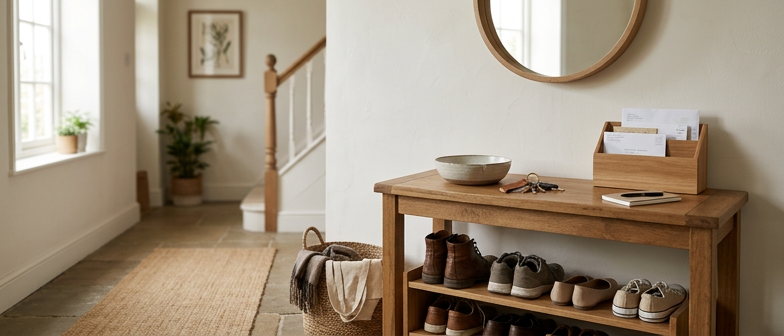
Shallow and visible spaces work better than deep, hidden ones. A low rack, short cabinet, or bench with space underneath can hold pairs without blocking movement. If the area is very open, a rug or mat can mark where outdoor items stop and the living space begins.
Lining up pairs once a day, or on a chosen day each week, keeps the container from turning into a mountain. When it is full, treat that as a signal to return extra pairs elsewhere instead of adding more organizers that tighten the space.
Here is one way to think about different approaches for footwear near the door:
| Setup style | Best for | Trade-off reference |
|---|---|---|
| Open rack or low shelf | Quick visibility and access | Looks busier, needs occasional straightening |
| Closed cabinet or chest | Cleaner look, visual calm | More steps to open and put items away |
| Bench with space below | Sitting to put items on/off | Limited height for bulkier options |
| Simple mat or tray only | Very small areas, few pairs | Little separation if use increases |
The aim is to match what you realistically do each day.
Layers, Bags, and Paper: Dividing a Small Space by Job
Layers and bags need their own home so they do not drift across chairs and floors. Hooks are helpful for grab-and-go items: one hook per person for a main outer layer and a daily bag keeps things simple. Extra pieces can live on hangers behind a door or in another storage area.
Bags benefit from predictable landings: a hook, a basket under a bench, or a dedicated shelf. The most important factor is repetition: the same spot, every time, within a few steps of the entrance.
Paper and small essentials need tighter containment. A tray, shallow basket, or narrow organizer on a console can hold keys, passes, and things that still need attention. A simple in/out rhythm helps: items land in one spot when you arrive and leave that spot only once they are read, signed, responded to, or filed.
Storage That Matches Real Habits
One helpful way to design this small area is to think in “steps”: how many actions it takes to put something away. The fewer steps for daily items, the more likely the area will stay steady without constant effort.
One-Step Spots: Hooks and Simple Dropping Zones
Anything you can hang or drop in a single motion is easier to handle in a busy moment. Hooks are especially useful in this kind of space.
Place them at a height that works for the people using them so no one needs to bend or stretch much. Aim for one everyday hook per person for outer layers and daily bags. For keys, a leash, or a pass, a tiny set of hooks near the door acts like a parking place.
The idea is to remove friction: no door to open, no lid to move, no container to slide out. Walk in, hang or drop, move on. When the simplest option is also the correct one, surfaces and flooring stay clearer.
Two- and Three-Step Spots: Bins and Closed Storage
Some things still need more containment. Open bins are useful “two-step” tools: you walk in, then drop the item over the edge. Assigning one container per person or per category (for example, gloves or small gadgets) keeps items from tangling together. Simple labels on the front can remind everyone what belongs where.
Reserve “three-step” storage—doors, drawers, deeper closet areas—for items you do not reach for every day. These often require opening something, placing the item, and closing it again.
A smooth arrival might look like this: hooks first for layers and bags, then bins for small extras, then closet or cabinet for backup items. When the layout follows the sequence of your entrance, the threshold acts like a filter, catching clutter before it scatters through the home.
Here is a way to compare these storage layers:
| Storage layer | Typical effort | Good for | Things to keep in mind |
|---|---|---|---|
| One-step (hooks) | Very low | Daily layers, main bag, leash | Can look busy if overfilled |
| Two-step (bins) | Low | Small accessories, shared items | Needs regular check to avoid dumping |
| Three-step (doors) | Moderate | Occasional gear, backup items | Works best with clear categories inside |
Short Daily Routines That Keep the Threshold Steady
Tiny routines tend to work better than rare deep resets in such a busy spot. Two brief passes a day can keep the area calm.
Morning: Quick Landing Check
Think of the entry as a small station. Once each category has a place—a mat for footwear, hooks for layers and bags, a container for keys, a spot for paper—walk past the area and take a couple of minutes to:
- Nudge stray footwear back to the mat or rack
- Hang loose layers and bags on their hooks
- Drop keys and wallet into their home container
- Stack or corral envelopes into a single place
This is enough to restore a sense of order after the rush of leaving.
Evening: Small Threshold Reset
The second small habit fits well near the end of the day. This is about returning the space to neutral so departures the next morning feel smoother.
A simple sequence might be:
- Clear surfaces: pick up spare sunglasses, toys, receipts, or parcels and return them to their zones.
- Sort the day’s envelopes: obvious clutter goes in recycling, important items move to a visible but contained spot.
- Limit footwear near the entrance to a modest number of pairs per person, then return extras to deeper storage.
- Straighten what stays: align the mat or rug, push a bench back into place, tuck umbrellas or gear into their container.
Linking this reset to an existing habit, such as after kitchen clean-up or before relaxing, can make it easier to remember. Over time, the area just inside the door starts to feel more like a support system than a daily obstacle course.
Q&A
-
How can I design Home Entryway Organization that fits different household members’ routines?
Start by observing when and how each person enters and leaves, then zone the entryway by user instead of by item type. Give every person a low-friction path: one hook, one shoe space, and one small bin. This reduces conflict, makes routines predictable, and limits negotiation about where things belong. -
What Shoe Storage Ideas work best for tiny or open entryways?
For small spaces, prioritize vertical and under-bench storage, plus a strict “capsule” shoe collection near the door. Use a narrow rack, slim cabinet, or wall-mounted rails, and pair them with a washable mat. Limit each person to two or three pairs here, rotating extras seasonally to deeper storage. -
How do I set up a reliable Key Drop Zone and Bag Placement Routine?
Place key hooks or a shallow dish at natural hand height, directly on the path you walk in. For bags, use one visible hook or basket per regular commuter. Practice a consistent script: unlock, hang keys, park bag, then remove shoes. Repeating the same order embeds the habit and prevents last-minute panics. -
What Mail Sorting Habits reduce paper piles without needing a full office?
Create three small, clearly labeled sections near the door: “To act,” “To file,” and “Recycle.” Sort standing up as soon as mail enters, keeping only action items visible. Time-box processing to a weekly ten-minute slot. This Light structure handles most paperwork without requiring a dedicated desk or file cabinet. -
How does a Clutter Reduction Setup support smoother Daily Exit Preparation?
Clutter drops when every exit item has a launchpad: shoes in front, bags and layers mid-zone, keys and wallet closest to the door. Keep only what you need for the current week here. Each night, reset those few essentials, so mornings become quick checks instead of room-to-room searches or frantic repacking.