
Tracing Ocean Microplastics from Source to Seafood: Methods, Pathways, and Shared Responsibility
Tiny fragments from packaging, clothing, and everyday products now travel from busy coastlines to distant waters, mixing with plankton, sediments, and the seafood people eat. Researchers and local groups are working to track where these particles come from, how they move, and what happens when they enter living organisms and coastal communities.
This story is part of DailySeekers's practical reading library across everyday topics.
From Everyday Items to Drifting Fragments
From the bottle in a bathroom to the wrapper around a quick snack, many familiar items shed tiny pieces long before they are thrown away. Synthetic fabrics lose fibres in the wash, plastic packaging flakes during use, and some personal care products and paints are made with small particles from the start. Once they detach, they behave more like dust than like solid objects.
Most of this material first reaches rivers and coastal waters. During laundry, wash water carries synthetic fibres to treatment plants, which are not designed to capture every tiny piece. Litter on streets is washed into drains during rain, and stormwater can move light plastic bits straight into nearby streams. Even when waste is collected, pieces can be blown from disposal sites or dropped during transport, eventually entering drainage channels.
Once in the water, these particles begin a long journey. Some float at the surface and drift with currents. Others sink, rise again, and ride turbulence until they meet slower, deeper flows. Over time, they spread from shorelines into open sea areas.
On the way, the plastic pieces change. Sunlight and waves crack them into even smaller fragments. Their surfaces pick up a coating of salts, organic matter, and microscopic life. This sticky layer makes it easier for metals and other pollutants to attach and can also attract algae and tiny animals.
When drifting particles meet plankton, nearby algae may grow more slowly and use light less efficiently. Some fragments stick directly to algal cells. Attached pollutants and the plastics themselves can enter food webs as small animals mistake them for food, influencing water quality, plankton health, and the way carbon and nutrients move through the sea.
Tools and Tricks for Finding Hidden Pieces
On research vessels, the work often starts with nets. A wide-mouthed trawl is towed behind a boat, skimming the surface or a set depth. The mesh is fine enough to trap small fragments while letting water escape. After a tow, the cod end, a small bag at the back, is rinsed into buckets. The result is a mix of seaweed, sand, plankton, and plastic pieces that has to be sorted.
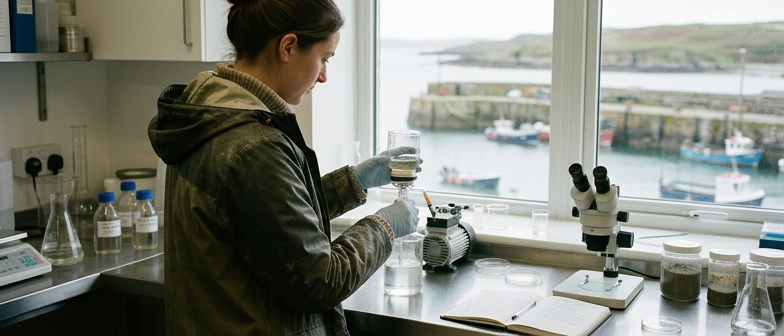
For smaller fragments, pumps are useful. Instead of dragging a net, pumps pull known volumes of seawater through filters. This method works well in calm bays, river mouths, or deeper layers where towing is difficult. The filtered pads or sieves are stored and labelled with location, depth, and time so that later counts can be linked to specific places and conditions.
On shorelines, volunteers and researchers sample sand and mud along fixed lines on the beach. They may collect sand cores or scrape the surface layer. Back in a field station or laboratory, the sand is dried, sieved, and sometimes mixed with saltwater so plastics float while heavier grains sink. This density trick helps separate fragments and pellets from natural material.
In the lab, sorting and identification begin. Under microscopes, particles are picked out by hand and counted by size and shape. To check whether a piece is truly plastic, teams use tools such as infrared-based methods or controlled heating. Some groups also place plastics in dishes with seawater and microbes to observe which organisms grow on them and whether fungi or bacteria begin to break down the material. Each step, from nets and pumps to benches, turns scattered bits into evidence about how much plastic is present and where it may be coming from.
| Sampling approach | Strengths in practice | Typical limitations or trade‑offs |
|---|---|---|
| Towed surface nets | Covers larger areas and gives a broad overview | Misses very small particles and deeper layers |
| Pump and filter setups | Captures smaller sizes and specific depths or sites | Handles smaller water volumes and needs power and storage |
| Shoreline sediment grabs | Reveals local hotspots and long‑term accumulation | Results can vary with tides, storms, and beach conditions |
From Plankton to People: Pathways Through Food Webs
Tiny bites and moving particles
Far from shore, the story often starts with plankton. These small drifters can mistake floating fragments for food. Lab and field work show that zooplankton are able to ingest particles similar in size to their usual prey. Once inside, these pieces may reduce feeding efficiency and energy, even if they later pass through the digestive system.
Small fish and filter feeders then eat these plankton. Along with protein and fats, they also take in plastic fragments and any pollutants attached to them. Many plastics can carry chemicals at levels higher than the surrounding water. Repeated meals over time increase this exposure.
Larger predators feed on small fish and invertebrates, moving particles and associated substances to higher levels of the food web. When materials build up in tissues faster than they are removed, this process is often described as bioaccumulation. The pattern does not stop with wildlife; it can extend to the seafood that people eat.
Shellfish, top predators, and human meals
Filter feeders such as shellfish occupy an important position in this story. Constantly pumping seawater, they can trap both plastic fragments and pollutants. Work on species such as oysters suggests that exposure can influence growth and reproduction, which matters both for coastal ecosystems and for people who depend on these animals as food or livelihoods.
As plastics and attached chemicals move up food chains, top predators can end up with the highest loads. When people eat seafood, they may also encounter whatever has accumulated along the way. Studies are still clarifying how much transfers to edible tissues, how the body handles different particles and chemicals, and what this could mean for health over time.
Contamination that begins with plankton does not remain at the bottom. Every step, from drifting plankton to human plates, shapes how tiny particles and their chemical passengers travel through ocean life.
| Food‑web level | Typical exposure route | Why researchers pay attention |
|---|---|---|
| Plankton and larvae | Direct ingestion of fragments in surrounding water | Early life stages can be sensitive to added stressors |
| Small fish and invertebrates | Eating exposed plankton and suspended particles | Form a bridge to larger predators and human harvests |
| Top predators and seafood for people | Repeated meals of exposed prey | Indicates how far particles and chemicals can travel |
Shared Responsibility and Practical Actions
Everyday choices that slow the flow
Shared responsibility can sound abstract, but it often begins with small, repeatable habits.
In daily life, two questions help: “Do I really need this item?” and “Where will it end up?” Choosing long‑lasting bottles, lunch boxes, razors, and shopping bags means fewer disposable products that can break into fragments. Gentle washing of synthetic clothes and using cooler settings can lower fibre shedding. Where available, filters on washing machines or laundry bags designed to catch fibres offer another step.
Waste handling also matters. Separating recyclable items, keeping food waste out of recycling bins, and returning items to official collection points lowers the chance that plastic escapes into drains, rivers, and the sea. None of these actions remove the problem completely, but they reduce the flow of new material into waterways while larger changes take shape.
How groups and policies share the load
Responsibility grows when neighbours, schools, and local groups move in the same direction. Beach or river clean‑ups, refill stations at events, and workshops on daily plastic use make the issue visible. Local campaigns can encourage refilling bottles, buying in bulk, and using reuse systems for takeaway packaging, which all cut the number of single‑use items entering circulation.
Decision‑makers have tools that individuals do not. They can set rules on packaging design, support deposit‑return or refill schemes, improve wastewater treatment, and require better filters in industrial and laundry systems. Public support for studies on tiny plastic particles in the sea, clearer product labelling, and backing for community projects help turn many small efforts into a more coherent response.
When individuals, communities, researchers, and authorities align their actions, each step to monitor particles, reduce waste, and share knowledge becomes more effective, helping to limit how far these tiny fragments spread through oceans and everyday life.
Q&A
-
How is ocean microplastics research evolving beyond simply counting particles?
Modern ocean microplastics research increasingly links particle data with hydrodynamic models, chemical analysis, and biological effects. Scientists track shapes, polymer types, and attached pollutants, then connect these with current patterns, organism behaviour, and human activities. This integrated view helps distinguish major sources, forecast hotspots, and prioritise risk‑based management actions. -
Which marine pollution sources are most under‑recognised and how are they traced?
Beyond obvious litter and fishing gear, under‑recognised marine pollution sources include textile fibres, tyre wear, road‑paint dust, and industrial plastic pellets. Tracing them combines chemical “fingerprints,” land‑use maps, and monitoring at river mouths, outfalls, and harbours. Comparing these patterns with production and transport data helps regulators target specific sectors and leakage points. -
What are the core ideas behind sampling methods basics for microplastics studies?
Sampling methods basics focus on representativeness, contamination control, and comparability. Researchers standardise mesh sizes, pumped volumes, and sediment depths, while wearing non‑synthetic clothing and using clean containers to avoid false positives. Recording metadata such as weather, tides, and currents allows results from different times and places to be combined into reliable regional assessments. -
Why are food chain concerns central to microplastics research awareness campaigns?
Food chain concerns resonate with the public and decision‑makers because they connect invisible particles to seafood safety, fisheries productivity, and cultural diets. Awareness campaigns use simple diagrams, local species examples, and citizen‑science data to explain trophic transfer, then link this to calls for upstream reduction, better wastewater treatment, and safer product design. -
How do coastal monitoring projects support plastic breakdown science and policy decisions?
Coastal monitoring projects provide long time‑series showing how plastic breakdown progresses from larger debris to micro‑ and nanoplastics under real conditions. By pairing field measurements with degradation experiments, researchers estimate residence times and fragmentation rates. These insights feed into models used by policymakers to evaluate bans, extended producer responsibility, and shoreline restoration strategies.