
Antarctic Ice Cores: Time‑Capsule Evidence for Ancient Air, Ocean Heat and Shifting Climate
Layer by layer, Antarctic ice preserves traces of ancient atmospheres, volcanic fallout, and shifting temperatures. By drilling deep into the ice sheet, researchers can compare trapped gases, dust, and chemistry across thousands of years, revealing how climate systems changed long before direct measurements existed.
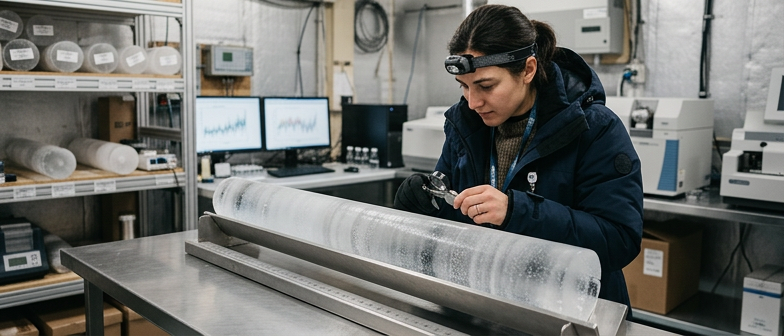
This story is part of DailySeekers's practical reading library across everyday topics.
How Falling Snow Becomes a Hidden Record
A landscape where snow rarely melts
Far from the coast, the Antarctic interior stays so cold that surface snow almost never melts. Each cold season adds a fresh layer, and because the air is dry and liquid water is scarce, those layers mostly stay where they fall. Over thousands of seasons, the layers stack up like pages in a very thick book.
As the pile grows deeper, the weight of newer snow presses on the older layers below. Fluffy crystals gradually compact into dense ice. Any dust, sea salt or tiny particles that fell with the snow are locked in place. The air between the grains is squeezed into sealed pockets that trap samples of the atmosphere from the moment the snow originally settled.
Near the surface, layers are still soft and easy to distinguish. Deeper down, the ice becomes more solid but the layering survives. A long core drilled from this stack works like a vertical timeline: the shallow ice is relatively recent, the deeper ice increasingly ancient.
Signals stored in the frozen layers
Inside a single core, several types of information are preserved together. Bubbles of air hold past levels of heat‑trapping gases. Dust reveals how dry, windy or stormy distant continents and oceans may have been. Tiny differences in the ice itself, such as shifts in its molecular make‑up, point to colder or warmer conditions when that snow first fell.
In some areas, cores reach far back into the past, capturing multiple swings between cold and warm phases. The slow fall of snow is turned into an archive of changing conditions beneath the feet of anyone standing on the present‑day surface.
| Feature in the ice | What it hints about the past | Typical use in studies |
|---|---|---|
| Dust and salt particles | Wind strength, dryness, nearby sea ice conditions | Reconstructing storms and atmospheric circulation |
| Ice composition patterns | Relative warmth or cold at the time of snowfall | Tracking long cycles between colder and warmer phases |
Trapped Air and What It Reveals
Tiny pockets as samples of earlier atmospheres
Layer after layer, snow settles, is buried, and slowly turns into ice. During compaction, pockets of the air sitting above the surface become trapped between grains, then sealed off as the ice becomes denser. Each depth in a drilled core therefore holds bubbles from a different moment in the past.
In specialised laboratories, core ice is cracked, crushed, or gently melted in closed systems so the gas inside can be collected. The resulting air is analysed for greenhouse gases and for stable isotopes that act as fingerprints of temperature and large‑scale circulation. Because the air itself is ancient, these measurements give direct information about past atmospheres instead of relying only on indirect clues.
Links between air, ice and oceans
When gas measurements are compared to other signals stored in the same ice, relationships appear. Periods with higher amounts of certain greenhouse gases tend to align with warmer conditions and shrinking ice sheets. Lower levels are associated with colder times, when continental ice expanded and global sea levels were lower.
Some cores capture repeated cycles between extended cold phases and shorter warm interludes. At specially chosen sites with very old ice, bubbles hold air from earlier warm worlds when oceans stood higher and polar ice covers were reduced. These records show that the atmosphere, temperature, land ice and ocean volume have been connected over very long intervals, and that significant changes can unfold when key thresholds are crossed.
| Air‑related clue | Aspect of climate it helps constrain | Example of its role |
|---|---|---|
| Greenhouse gas levels | Strength of natural warming and cooling phases | Testing how temperature responds to changing gases |
| Isotopes in the air | Large‑scale circulation and source regions | Checking shifts in wind patterns and moisture paths |
Reaching Ancient Layers: From Surface Patches to Deep Drills
Blue ice areas as shortcuts to old material
On most of the ice sheet, the deepest and oldest layers are buried under great thicknesses of younger snow and ice. Blue ice areas form an exception. Strong winds scour away fresher snow and polish the surface, while ice flow patterns slowly push deeper layers upward. The result is a blue‑tinted surface where very old ice can lie close to the open air.
Because of this uplift, researchers can sometimes reach ancient material with only shallow drilling or surface sampling. At certain blue ice sites, grains of dust locked in the ice have been traced back to different types of source regions. In one case, the main sources appeared to shift from distant continental dust to more local volcanic and ice‑free areas around a large open embayment, indicating environmental changes during a past warm phase.
Kilometer‑scale cores for continuous histories
When the goal is to build a long, nearly unbroken timeline of changing conditions, researchers turn to deep drilling projects. At carefully chosen high points on the ice sheet, the ice is thick enough that a single core can extend for several kilometres, sometimes all the way down to the underlying rock. One well‑known core of this type preserves many swings between cold and warm intervals, with bubbles of ancient air and shifts in ice chemistry tracking changes in greenhouse gases and temperature.
Some inland sites are being targeted specifically to reach even older ice. Drills there may pass through more than two kilometres of frozen material in search of layers formed before a major shift in Earth’s climate rhythms. In certain coastal regions, drilling continues beyond the base of the ice into the sediments beneath. Those layers hold traces of changing ice cover and ocean conditions over very long timescales, linking present‑day ice with older environmental changes recorded below.
What Past Patterns Mean for Future Risks
Reading frozen clues in a warming world
The stacked layers and trapped air in Antarctic ice act like pages in a long diary, recording how conditions at the surface, in the ocean and in the air have evolved together. By comparing greenhouse gas levels in bubbles with temperature indicators from the surrounding ice, researchers see that past warming and cooling events tracked changes in atmospheric composition rather than unfolding independently.
The same archives also record changes in land ice and sea level. When the Antarctic ice sheet shrank during warmer intervals, sea level rose; when it expanded in colder phases, seas fell. Sediments hidden under the present ice suggest that areas now deeply frozen were once at least partly ice‑free. These clues indicate that large ice sheets can retreat substantially when warming pushes them beyond certain thresholds, even if the exact timing remains uncertain.
These records do not provide a fixed schedule for future change, but they narrow the set of outcomes that are physically plausible. They also help distinguish between natural variability and trends linked to ongoing increases in greenhouse gases.
From ancient archives to modern decisions
Around Antarctica today, floating sea ice is changing in ways that affect how much sunlight is reflected back into space. Less seasonal ice cover means darker ocean surfaces that absorb more heat, which can encourage further melting and alter wind and storm patterns. Those changes influence conditions beyond the polar regions.
Measurements from ice cores feed directly into computer models that simulate climate and ice‑sheet behaviour. By checking whether these models can reproduce known changes from the distant past when given realistic greenhouse gas levels and sunlight patterns, researchers gain insight into how reliable the models may be for different ranges of future warming.
Uncertainties remain, especially about how quickly major glaciers might retreat and how fast sea level could rise under specific warming pathways. Instead of pointing to one precise outcome, the frozen record supports ranges of risk. It underlines both the long‑term potential for substantial sea‑level rise and the importance of curbing additional warming to reduce the likelihood of crossing thresholds that would commit the planet to much larger, and harder‑to‑reverse, changes.
Q&A
-
How does Antarctic Ice Core Science extend beyond simple temperature reconstructions?
Antarctic ice core science now integrates physical, chemical and biological signals to reconstruct complex climate processes, not just temperatures. Researchers combine dust flux, volcanic markers, sea‑salt chemistry, and trapped gases with advanced statistics to infer changes in storm tracks, ocean ventilation, ice‑sheet stability and even wildfire patterns over multiple glacial–interglacial cycles. -
Why are Ancient Climate Records from Antarctica crucial for testing climate models?
Ancient climate records provide boundary conditions and targets for climate model evaluation under very different greenhouse gas levels and orbital configurations. By forcing models with reconstructed CO₂, methane, and ice‑sheet geometries, scientists test feedback strengths, cloud responses and ocean circulation shifts, helping constrain equilibrium climate sensitivity and long‑term sea‑level commitment. -
What new insights does sophisticated Ice Layer Analysis offer?
Modern ice layer analysis uses micron‑scale imaging, laser ablation chemistry and continuous flow analysis to resolve annual or even seasonal signals. This reveals how abrupt events, such as volcanic eruptions or shifts in sea‑ice extent, cascade through the climate system, clarifying leads and lags between atmospheric circulation, ocean upwelling and polar temperature responses. -
How does Atmospheric Gas Trapping improve our understanding of carbon cycle dynamics?
Atmospheric gas trapping preserves discrete snapshots of past air, allowing reconstruction of abrupt CO₂ and methane jumps. Coupled with isotope ratios and dust indicators, these records show how quickly natural carbon sources and sinks, like Southern Ocean upwelling or permafrost, responded to past warming, informing expectations for modern feedback speeds and magnitudes. -
What makes Polar Research Methods in such Extreme Environment Science uniquely challenging?
Polar research methods must endure low temperatures, isolation and logistical limits, so teams use autonomous drilling systems, low‑contamination field labs and satellite guidance to target promising sites. Long term climate evidence demands precise dating strategies, such as matching cosmogenic isotopes and volcanic layers, while ensuring continuous power, safety and data transmission in remote camps.