
Badminton Basics: Grip, Footwork, and Serve for New Players
Curious how badminton actually works beyond casual backyard rallies? This guide walks through badminton basics—equipment, court lines, grip, serve, footwork, and scoring—so you can step onto a standard court knowing what you’re doing and what realistic limits beginners usually face.
This story is part of DailySeekers's practical reading library across everyday topics.
What Makes Badminton a Beginner-Friendly Racket Sport
Badminton attracts many beginners because it combines clear rules, basic equipment, and an active pace. The main aim is to hit the shuttle so it lands inside the opponent’s court or forces an error, using a light racket on a marked playing surface. Typical equipment includes a racket, shuttlecocks, and shoes with good grip, usually for indoor courts, although casual games are also played in parks or backyards. Compared with some other racket sports, the lighter gear and more manageable shuttle speed at recreational levels can help new players keep rallies going while they learn.
This chapter outlines the essentials that new players usually meet first, including how a standard game is scored to 21 points, how court lines differ for singles and doubles, and how to hold and swing the racket more effectively. It is not a substitute for formal coaching or the complete official rules, and it does not cover every tournament or local variation. Instead, it gives a broad overview so readers know what to expect on court, while noting that details can vary by club, community center, or school.
Essential Badminton Equipment and Court Layout
To start playing badminton, only a few pieces of equipment are necessary, but suitable gear makes play safer and more comfortable. A basic setup includes a lightweight racket, shuttlecocks, non-marking shoes with good grip, and loose sports clothing. Recreational rackets are usually a bit heavier and more durable, which helps beginners who often mis-hit the shuttle. Players in club settings tend to use lighter rackets and feather shuttles for better control, accepting that they wear out faster and cost more. For casual games in a park or multi-purpose gym, many people choose plastic shuttles because they last longer and cope better with light wind. Whatever the level, it is useful to check that racket strings are not broken, the handle grip is not too smooth, and shoes provide basic ankle support, while understanding that even good equipment cannot remove all risk of injury.
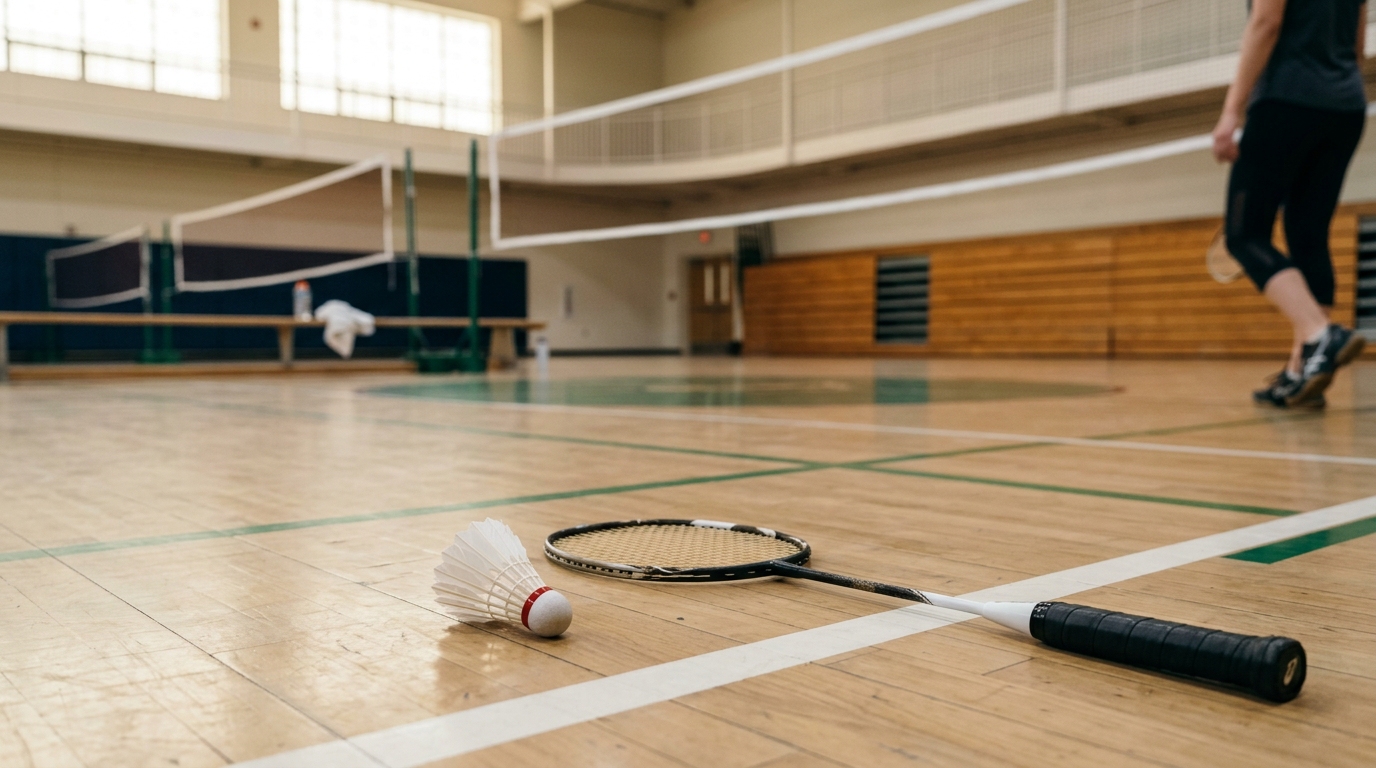
A badminton court is a rectangle split in half by a net, and the painted lines decide whether a shuttle is in or out. The outer lines mark the boundary for doubles, while the inner side lines define the narrower singles court. Close to the net, the short service line shows how near a legal serve may land, and at the back of the court the long service lines indicate the deepest point a serve may reach, with a separate rear line used only for doubles. A center line divides each side into left and right service courts, and the shuttle must land in the correct box depending on the score and where the server stands. Because any part of a line counts as in, learning these markings helps beginners follow scoring decisions and reduces arguments in both informal and organized matches.
| Item type | Typical beginner choice | Advantages | Limitations | Best suited for |
|---|---|---|---|---|
| Racket | Heavier recreational frame | More durable, forgiving on mis-hits | Less maneuverable, slower reactions | New players, casual games |
| Racket | Lighter club-style frame | Quicker swings, finer control | More fragile, grip needs more care | Developing players, club sessions |
| Shuttlecock | Plastic shuttle | Longer lasting, handles light wind | Less precise flight, different feel | Parks, multi-purpose gyms |
| Shuttlecock | Feather shuttle | Better touch, more consistent control | Wears out faster, needs careful storage | Organized practice, club play |
| Footwear | Basic non-marking court shoes | Good grip, protects court surface | Limited cushioning and support | Occasional indoor matches |
| Footwear | Supportive indoor sports shoes | Improved ankle support, more comfort | May feel heavier, needs regular inspection | Frequent practice, longer sessions |
Understanding Badminton Court Lines and Playing Areas
On a standard badminton court, the outer side and back lines mark the boundaries for doubles, while singles uses the inner side lines but the same long back line. The short service line runs parallel to the net, and the center line splits each half into left and right service courts. In singles, the serve must land in a long, narrow box that uses the inner side line and the far back line. In doubles, the legal receiving space is short and wide, using the outer side line and the nearer long service line.
These markings matter for scoring because a rally ends when the shuttle lands fully outside the relevant boundary for singles or doubles. Beginners can remember the layout by thinking singles is narrow and long, doubles is wide with a slightly shorter serve area. Before playing, walking around the court and tracing the service boxes with your eyes helps you judge in or out more confidently.
Fundamental Techniques: Grip, Serve, and Footwork
Before learning advanced plays, it helps to know how the racquet should sit in your hand. A basic forehand grip is often compared to shaking hands with the handle. The thumb and index finger form a relaxed V along the top edge, while the remaining fingers wrap around without squeezing. This neutral hold lets you change the racquet angle quickly for both flat hits and gentle shots without constantly changing grip. If the handle turns in your hand or your wrist feels tense, you are probably holding the racquet too tightly or at an awkward angle, which reduces control and slows your reactions.
Serving is how every rally starts, so a simple, legal serve is an important part of badminton basics. Many beginners start with a low, controlled serve that travels just over the net into the correct service box, keeping the shuttle under waist height at contact and striking it below the server’s hand. The priority is consistency, accuracy, and avoiding faults that give away points. As confidence grows, players can try slightly higher or deeper serves, but it remains important to repeat the same motion and remember that formal competitions use specific service rules that may be stricter than casual games.
Good footwork helps you reach the shuttle without overreaching or losing balance. Instead of standing flat-footed in the middle of the court, keep a light, shoulder-width stance with your weight on the balls of your feet and be ready for small adjustment steps. Avoid long lunges that strain the knees or ankles. Simple patterns, such as moving from a ready position to the front of the court and back, or side-to-side shuffles that return you to the center, can be practiced even without hitting a shuttle. These basic drills support coordination and movement skills while reminding players to respect their physical limits.
Developing a Comfortable Badminton Grip
A relaxed handshake grip is the base for most badminton strokes and helps you handle the racket efficiently. Hold the handle as if greeting someone, with the V between thumb and index finger along the top edge and a small gap between your fingers. This neutral position, combined with a handle size and grip thickness that suit your hand, lets you switch between forehand and backhand without squeezing too hard and reduces strain on the wrist and forearm.
Beginners often press all fingers flat, hold too close to the shaft, or clench the handle, which reduces control and slows racket speed. A comfortable grip still needs small adjustments for different shots, and preferences differ. Pay attention to any pain or numbness when using your equipment and change how you hold the racket instead of forcing a single perfect grip.
Basic Serving Options for New Players
A legal badminton serve starts with both feet on the court, the shuttle held below your waist, and the racket moving in one smooth forward swing as you hit. Beginners usually learn a short serve aimed just over the net into the front of the service box, especially in doubles, and a high, deep serve toward the back of the court in singles to gain time to move into position.
The serve only counts if it lands in the correct service area for the current score, so players must know when to stand on the right or left side under the scoring system being used. Common faults include striking the shuttle above waist height, stepping on or over the service line before contact, missing the shuttle, or sending it outside the proper service court.
Q&A
-
What equipment is needed for basic badminton practice?
Use a light racket, a few shuttlecocks, comfortable sports clothing, and non‑marking shoes with decent grip. Expensive gear is optional for beginners. -
How do singles and doubles court lines differ?
Singles play uses the inner side lines and the long back line. Doubles rallies use the outer side lines and the same back line, but serves cannot pass the shorter long‑service line. -
What is a simple way to learn a standard badminton grip?
Hold the racket like a handshake, with a relaxed V between thumb and index finger on the top edge of the handle, and keep the fingers slightly spread. -
What basic serving rules should new players follow?
Both feet stay on the court, the shuttle is hit below waist height, and the racket moves forward in one smooth swing. Beginners usually practice both short low and high deep serves. -
How does rally scoring work in badminton?
Games typically go to 21 points, win by two, with a maximum of 30. Every rally gives one point to the winner, and clubs may adjust formats while keeping this structure.