
Forest Carbon Cycle Basics: From Tree Growth to Soil Storage and Climate Signals
Every woodland is a living engine, quietly shifting carbon between air, wood, fallen leaves and the soil beneath our feet. From young stands recovering after disturbance to old groves still thickening their trunks, subtle exchanges of gases, nutrients and energy shape local climate patterns and challenge how researchers track change over time.
This story is part of DailySeekers's practical reading library across everyday topics.
From Sunlight to Wood: Turning Gas into Solid Matter
Photosynthesis and the making of plant structure
Leaves start the whole story by trading light for carbon. They take in carbon dioxide from the air and water from the ground, then use the energy in sunlight to build carbohydrates and release oxygen. This photosynthesis step is how invisible gas becomes solid plant matter that you can see and touch.
The new carbohydrates do not stay in the leaves. Trees move them around like an internal building supply. Some become sugars that fuel everyday activity, but a large share is turned into structural carbon, especially cellulose and lignin. These tough compounds make trunks rigid, bark protective, and branches strong. With each breath of carbon dioxide that passes through its leaves, a tree quietly adds more wood, bark and roots.
Where that carbon is stored in a wooded landscape
Once carbon is locked into wood, it is shared across different parts of the stand. Living trees are the most visible storage pool: trunks, branches, foliage and roots all hold carbon for as long as the tree remains alive and standing. As trees age, more carbon tends to collect below ground in roots and in the soil close around them.
When a leaf falls or a branch breaks, the carbon inside shifts location but does not vanish. Dead wood, leaf litter and soil organic matter together hold a large share of the total. Decomposers slowly return some of it to the air as carbon dioxide, while a portion can stay in soils for long periods. A growing stand is therefore both a changing system and a substantial storehouse, constantly pulling in carbon from the air and holding it in wood and earth.
| Storage pool | Typical contents and role | Tends to change when… |
|---|---|---|
| Living vegetation | Trunks, branches, leaves, fine and coarse roots; main active store | Growth speeds up or slows; disturbance removes trees |
| Dead wood and litter | Fallen branches, logs, leaf layers on the surface | Disturbance adds debris; decomposition progresses |
| Soil organic material | Mixed plant remains, root fragments, microbial products | Soils are disturbed, drained, or protected |
After Leaves Fall: Roots, Microbes and Hidden Soils
Underground activity after litter reaches the ground
Once leaves hit the ground, the story shifts from canopy to soil. The carbon that trees pulled from the air now sits in fallen leaves, fine roots and bits of dead wood. Gravity brings that material down; roots and soil life decide where it goes next.
Roots keep working even when branches seem quiet. Many trees send sugars belowground to feed living roots and tiny root hairs. Some of those roots die and are replaced, mixing fresh carbon straight into the soil. In this sense, roots are constantly trading carbon with the soil: taking up water and nutrients while leaving behind dead tissue and small releases of carbon‑rich compounds.
Microbial breakdown and the slow return to the atmosphere
Soil microbes, fungi and small invertebrates begin breaking down the litter layer. They use the carbon in dead leaves and roots as a food source. Part of that carbon becomes new microbial cells or more stable organic matter; part is released back to the air as carbon dioxide during respiration.
Whether more carbon stays in the soil or returns quickly to the atmosphere depends on several conditions. Moisture, temperature and how often the soil is disturbed all matter. Cool, relatively stable soils tend to build up more organic matter. Warmer, frequently disturbed soils usually lose carbon faster. Wooded areas act as net long‑term stores only as long as this underground balance leans slightly toward keeping more carbon than is released.
Switching Roles: From Storehouse to Source and Back Again
Growth, respiration and disturbance
A stand does not stay a strong carbon store forever. Its role is more like a bank account: deposits come in, withdrawals go out, and the balance changes with time and events.
When trees are young and growing quickly, they pull in large amounts of carbon dioxide through photosynthesis and lock it into wood, leaves and roots. At this stage, the area usually acts as a strong net store. The soil also begins to accumulate carbon as fallen leaves and dead roots are mixed in by organisms.
As the stand matures, growth gradually slows. Large, older trees still hold a great deal of carbon, but the extra amount added each year becomes smaller. At the same time, respiration from trees, animals and microbes releases carbon back to the air. In some older stands, the inflow and outflow can roughly balance.
Disturbances can flip that balance quickly. Severe fires, storms, insect outbreaks or large harvest events can suddenly remove or kill many trees. Decomposing or burning wood releases a pulse of carbon. For a period after such an event, the affected area can shift from a net store to a net source.
If the land remains wooded and trees regrow, the direction can change again. New seedlings and saplings start another phase of rapid uptake, gradually turning the area back toward being a sink. How quickly this happens depends on climate, soil, the mix of tree species and how the land is managed. Age, recent history and ongoing decisions all interact within the broader cycle that links land, air and living things.
| Stand situation | Likely carbon role (generalised) | Key influences on the balance |
|---|---|---|
| Young, rapidly growing | Often a strong net store | Fast tree growth, building biomass and soil inputs |
| Mature, stable structure | Close to balanced inflow and outflow | Slower growth, steady respiration |
| Recently disturbed | Often a temporary net source | Decomposition or combustion of killed material |
| Recovering after disturbance | Gradual shift back toward net storage | Regrowth rate, management, soil and climate |
Watching Wooded Landscapes Breathe: Field Tools and Remote Views
Measuring trees, soils and gas exchange on the ground
To watch a stand “breathe” in a measurable way, researchers often begin with simple field tools. Measuring tapes, diameter tapes and handheld laser rangefinders record tree height and trunk size. From these dimensions, they estimate how much biomass, and therefore how much carbon, each tree contains.
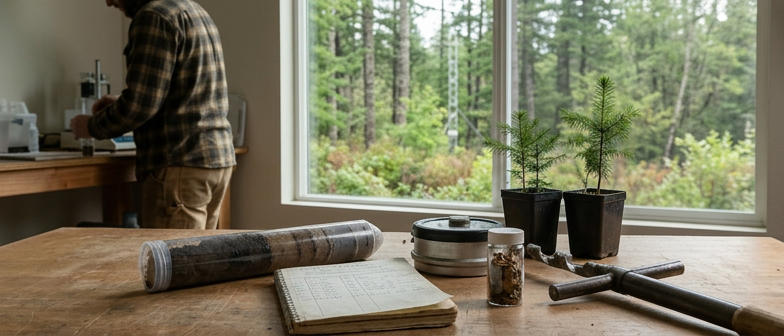
In some cases, they cut or sample a limited number of trees to create equations that relate trunk size to total mass. In wetter areas, peat augers and soil corers bring up cylinders of mud or peat. These samples show how much carbon is stored underground, which can be as important as the above‑ground stock. Long‑term plots, revisited over many years, show whether a stand is gaining or losing carbon overall.
Gas analyzers and small chambers add another layer of detail. Sealed chambers placed on the soil surface or around leaves measure how much carbon dioxide moves in or out over minutes to hours, turning exchanges of gas into numbers that can be compared between sites and seasons.
Looking from above: towers and satellite views
Field plots provide rich detail but only for limited patches of ground. To see the breathing of wider areas, researchers use instruments that watch from above.
Flux towers extend above the canopy with sensors that track wind and gas concentrations. By examining how carbon dioxide moves with turbulent air, they infer how much carbon an entire patch of forest takes up during daylight and releases at night. These continuous records help reveal daily and seasonal patterns of photosynthesis and respiration.
Satellites add an even broader view. They detect changes in tree cover, vegetation color and, in some cases, canopy height. Combined with geographic information tools, repeated images become maps of biomass and carbon stocks across large regions. When tree cover is cleared, burned, restored or managed for longer‑lived wood products, changes in these maps help show how the overall balance shifts, indicating whether the landscape behaves more like a net sink or a net source over time.
Q&A
-
What are the key components of the forest carbon cycle basics that scientists focus on?
The forest carbon cycle links atmospheric carbon dioxide with vegetation, dead organic matter and soils through photosynthesis, respiration, decomposition and disturbance. Scientists quantify inputs from photosynthesis, outputs from ecosystem respiration and losses from fires or harvests, then compare these with changes in biomass and soil carbon storage to determine whether a forest is a net sink or source. -
How does tree growth and carbon allocation differ between fast‑growing and old‑growth forests?
Fast‑growing stands allocate a larger share of carbon to new wood, foliage and fine roots, rapidly increasing biomass and short‑term carbon uptake. Old‑growth forests channel more carbon into maintenance respiration, defense compounds and below‑ground structures. Net carbon gain slows, but substantial long‑lived carbon remains locked in large stems, coarse roots and complex soil layers, stabilizing landscape‑scale stocks. -
Why is soil carbon storage often considered more climate‑relevant than above‑ground biomass?
Soil carbon can persist for decades to millennia, outlasting typical tree lifespans and buffering short‑term disturbance impacts. Although harder to measure, deep and stable soil pools respond slowly to climate and management, influencing long‑term atmospheric carbon dioxide levels. Protecting soil structure, moisture and organic horizons therefore underpins durable climate benefits from forest conservation and restoration strategies. -
How do ecosystem respiration measurements support climate research links and modeling?
Ecosystem respiration integrates carbon dioxide released by plants, microbes and animals, providing a key flux for carbon budget models. Continuous measurements from flux towers calibrate climate models that predict future feedbacks between warming and forest carbon. These datasets reveal how heatwaves, droughts or storms shift respiration rates, improving projections of forest vulnerability and global carbon‑cycle sensitivity. -
What forest monitoring methods are most useful for building environmental science foundations in policy?
Combining permanent plots, eddy‑covariance towers and satellite observations provides multi‑scale evidence linking management to carbon outcomes. Plot data validate remote‑sensing products, while towers reveal short‑term flux dynamics. Together, these methods inform national greenhouse‑gas inventories, guide certification standards, and support nature‑based climate solutions by quantifying credible, verifiable forest carbon changes over time.