
Reading a River’s Story: From Water Clarity to Aquatic Life in Community Stream Monitoring
Freshwater systems reveal their condition through patterns that anyone can learn to observe. When people pay attention to water clarity, aquatic life, and seasonal changes, streams and rivers become more than scenery—they become living records of ecological health and community stewardship.
This story is part of DailySeekers's practical reading library across everyday topics.
Looking Past “Clear or Cloudy”: Reading Everyday Water Clues
Water that looks perfectly transparent may seem “healthy,” while cloudy flow feels worrying. Both impressions are only starting points. Glass‑like water can still carry nutrients, bacteria, or tiny algae cells that are invisible from the bank. A slightly murky tint, especially right after rain, may simply mean that fine sediment was stirred up and will soon settle again.
Color adds more information. Greenish water can point toward algae growth, often linked with extra nutrients washing in from surrounding land. Brown water may carry soil from upstream erosion, especially after heavy runoff. A tea‑colored, amber tone commonly reflects leaves and woody material breaking down in wooded catchments. Watching how these hues shift shows whether conditions return to a familiar pattern or drift toward stress.
Movement also carries clues. Fast, choppy sections tend to hold more dissolved oxygen, which many fish and aquatic insects need. Still pools warm more easily and may hold less oxygen, particularly just before sunrise. Noticing where bubbles linger and where they vanish offers a rough sense of how well water and air are mixing.
Surface features deepen the picture. Foam that gathers after storms or below riffles can form naturally from decaying leaves and other organic matter. Bright white, very stable foam may instead point to soaps or similar substances entering the channel. Iridescent films can be caused by pollutants, but naturally occurring bacteria sometimes create similar patterns. Gently poking a film with a stick and observing whether it cracks like broken glass or swirls back together can help distinguish between them. These observations can turn a casual walk into a quiet form of creek‑side investigation.
When Conditions Shift: Flow, Temperature and Storm Patterns
Streams rarely remain in one steady state. Flow, warmth, and storm timing keep changing, and together they rewrite life’s ground rules for everything in the channel.
When storms arrive, water levels often rise quickly. Faster, deeper flow can scour bed and banks, carrying sediment and organic fragments downstream. This boosts turbidity, cutting down how much light reaches algae and submerged plants. Runoff also delivers nutrients from nearby soils and hard surfaces. In modest amounts, those inputs can support growth; when they are intense or frequent, they can overwhelm natural cycles and place extra stress on the invertebrates living among stones and roots.
As temperature rises, water holds less dissolved oxygen. Many fish and invertebrates need more oxygen under warm conditions because their metabolism speeds up. That mismatch can leave sensitive species struggling, especially when flows are low and fresh, cooler water is limited. Long warm spells combined with calm surfaces may further reduce oxygen, sometimes contributing to sudden die‑offs of fish or other organisms.
Along the banks, riparian vegetation acts as a buffer. Root systems help anchor soil during storms, reducing erosion and sediment delivery. Overhanging branches cast shade that can keep water cooler on hot days, while fallen leaves and woody debris provide habitat structure and food for aquatic food webs. Long dry spells shrink wetted width, lower water levels, and concentrate pollutants. Extended low‑flow periods can weaken the protective effect of bankside cover.
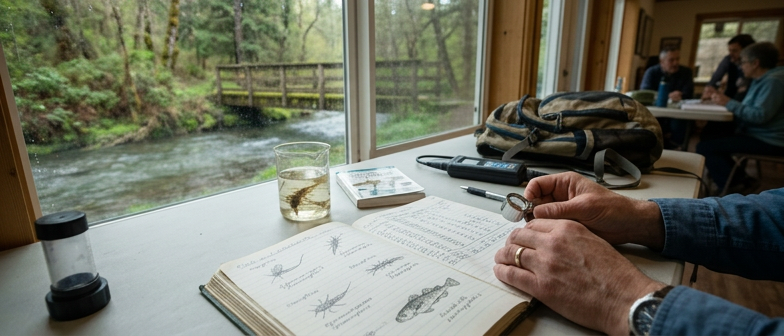
A simple field notebook that notes storm timing, water level, temperature changes, and how banks respond already creates a seasonal storyline. With repeated visits, many observers begin to recognize recurring patterns: familiar pulses after rain, typical warm‑season low flows, and the thresholds when pools shrink or riffles reappear.
| Seasonal situation | Typical stream response | What a local observer might note |
|---|---|---|
| Short storm after dry spell | Quick rise in turbidity, brief surge in flow | Water turns brown, foam appears below riffles, bank edges freshly scoured |
| Prolonged warm period | Lower oxygen, warmer pools, stressed species | Fish seen near inflows, fewer active insects at dawn, more surface film |
| Extended low‑flow stretch | Narrower channel, concentrated pollutants | Exposed stones, shrinking pools, stronger odors in slow sections |
Living Clues: Insects, Fish and Plants as Witnesses
Insects: Small Creatures, Long Memories
Along many small channels, the most revealing residents are often the least noticeable. Aquatic insects spend much of their lives underwater, so their presence, absence, and diversity reflect conditions over weeks or months rather than just a single day.
Some groups are especially sensitive. Mayflies, stoneflies, and caddisflies tend to favor cool, well‑oxygenated, relatively clean water. Where several types of these insects appear in good numbers, they usually indicate that conditions have been fairly stable and supportive. When they decline or disappear and only a few tolerant species remain, it often points toward cumulative stress from pollution, warming, or physical disturbance of the bed.
Simple surveys look at which insect groups appear under stones, in leaf packs, or along submerged roots, how abundant they are, and how that mix changes with seasons or upstream–downstream position. Gradual shifts in this community can flag emerging problems long before dramatic events like fish die‑offs or dense surface scums occur.
Fish and Plants: Larger Signals in the Landscape
Fish offer another layer of evidence, tied closely to channel shape, flow patterns, and longer‑term trends in temperature and water quality. A reach dominated by a few hardy generalists can hint at simplified habitat or repeated stress. In contrast, a varied mix of native species that use riffles, pools, and margins in different ways usually reflects a more complex, stable system.
Aquatic plants reshape the stage for everyone else. Stands of native vegetation provide shelter from currents, hiding spaces from predators, and surfaces for insect eggs or algae. When these stands are replaced or overshadowed by invasive plants introduced from gardens or aquariums, habitat quality can change even if the water still looks clear. Fish that rely on particular plant structures may struggle, insect diversity may fall, and the food web can become less resilient to further disturbance.
Together, insects, fish, and plants act like living testimony of how conditions have evolved. Careful observation over time can reveal where streams are holding steady, where they are slipping, and where small adjustments on land or along banks might make the most difference.
| Living indicator group | What it tends to reflect | When a change may raise questions |
|---|---|---|
| Aquatic insects | Recent water quality, oxygen, fine‑scale habitat | Loss of sensitive groups, rise of only a few tolerant forms |
| Fish community | Longer‑term flow and channel patterns | Shift toward a small set of hardy species or loss of size ranges |
| Aquatic plants | Light, nutrients, and habitat structure | Replacement of diverse native stands by a single dominant type |
From Field Notes to Shared Insight
Making Observations Comparable
Many local efforts begin with simple notes: “mayflies under rocks,” “water warm to the touch,” “flow low and slow.” Once written in a consistent way and stored together, those same observations become a traceable pattern that can be compared across sites, dates, and seasons.
A key step is deciding what to record each time. Some groups focus on visible macroinvertebrates and use their presence as a recurring indicator of creek condition. Others add DNA‑based records, which can reveal many more organisms than traditional sight‑based identification. These choices shape which trends appear when information from many places is pooled.
Consistency matters. Using the same units for temperature and flow, similar categories for bank and bed habitat, and clear labels for collection methods helps ensure that observations from one day or team can be meaningfully compared with another. With that groundwork, patterns like seasonal peaks in certain insects or typical turbidity levels after storms become easier to interpret.
Linking Local Effort to Broader Questions
As observations become more standardized, they can feed into larger shared collections curated by community groups, educators, or research teams. With enough consistent entries across many creeks and rivers, it becomes possible to explore broader questions: which visible stressors tend to matter most, where organisms keep pace with changing conditions, and which nature‑based actions along banks appear to support recovery.
For the individual observer, the habit of writing down what is seen, felt, and measured along a familiar reach turns everyday curiosity into a gradual, grounded understanding of local freshwater. Over time, that understanding can guide small choices—such as how to plant and protect riparian vegetation or when to focus extra attention after storms—that support the resilience of the nearby stream and its hidden residents.
Q&A
-
How does freshwater ecosystem monitoring help identify long‑term trends in small urban streams?
Freshwater ecosystem monitoring tracks physical, chemical, and biological changes through repeated observations. By comparing data on flow, temperature, clarity, and species presence over seasons, monitors can distinguish natural variability from emerging degradation, pinpoint when shifts begin, and relate them to land‑use changes, stormwater infrastructure, or restoration actions. -
What are practical stream health indicators that community groups can track without laboratory equipment?
Community groups can reliably track stream health indicators such as flow patterns, water clarity measures using simple Secchi tubes or visibility targets, basic temperature readings, counts of key aquatic species, bank stability notes, and presence of nuisance algae. Recording these consistently provides a robust, low‑cost picture of ecosystem condition and stress. -
Why are water clarity measures alone not enough to judge habitat quality in creeks?
Water clarity measures mainly reflect suspended particles and sometimes algae, but many pollutants are dissolved or attached to fine materials that remain unnoticed. Habitat quality also depends on flow diversity, substrate type, cover, temperature, and oxygen. Combining clarity assessments with aquatic species observation gives a more accurate view of stream health. -
How can community monitoring methods support professional scientists and local decision‑makers?
Community monitoring methods generate frequent, site‑specific observations that professionals often lack due to budget or staffing limits. When data follow simple, shared protocols, scientists can integrate them into broader assessments, while councils or agencies use findings to prioritize restoration, evaluate regulations, and engage residents in evidence‑based watershed planning. -
In what ways do seasonal water changes influence habitat quality awareness for local observers?
Seasonal water changes alter temperature, flow, and habitat structure, shifting which organisms can thrive. Observers who track these cycles learn to recognize typical seasonal patterns versus warning signs, such as unseasonal low flows or prolonged turbidity. This awareness sharpens interpretation of monitoring results and highlights vulnerable periods for targeted protection efforts.