
Coral Reef Restoration Meets Climate Stress: Nurseries, Monitoring Tech and Resilient Habitats
Coral communities are being reshaped by warming seas, declining oxygen, and shifting water quality, yet new research is revealing ways to help them persist. Scientists now pair ocean-based nurseries with genetic screening, climate-informed site choices, and advanced spatial imaging to track growth, structure, and survival. Together, these tools are changing how damaged reefs are rebuilt.
This story is part of DailySeekers's practical reading library across everyday topics.
Why Some Colonies Cope While Others Fail
Heat: When “a Bit Warm” Turns Into a Crisis
Many reef-building animals already live close to their comfort limit. A small temperature rise over a short period can sometimes boost growth, but a longer or stronger heatwave pushes them into trouble. The tiny symbiotic algae that provide most of the food begin to malfunction. If the stress carries on, the host expels these algae, turns pale or white, and loses a critical energy source.
Colonies do not reach this breaking point at the same time. Individuals that frequently experience small, repeated hot spells sometimes perform better in controlled heat tests than expected. Their cells appear more “trained” to handle higher temperatures, at least within a modest range. Yet once both heat and exposure time cross a threshold, even these relatively tough colonies can lose their algae or die.
Researchers use laboratory and field experiments to explore these limits. By tracking how different lineages handle gradual warming versus sudden spikes, they can identify families that keep feeding and growing under conditions that cause others to fail. These differences feed directly into restoration planning, because they highlight which parent colonies might pass on more stress‑tolerant traits.
Low Oxygen: The Hidden Partner in Stress
Heat rarely acts alone. Warm water naturally holds less dissolved oxygen, and calm, still periods can reduce oxygen levels even further. At the same time, metabolism in coral tissue speeds up, increasing the demand for oxygen. Just when the animals need more oxygen, less is available.
Some species or individual colonies keep functioning during these low‑oxygen episodes. They maintain basic processes such as feeding and tissue repair, even under combined heat and oxygen stress. Others falter early, showing reduced activity or tissue damage before full bleaching appears.
Natural swings in temperature and oxygen sort colonies into those that can bounce back after a hot spell and those that cannot. Understanding these patterns helps guide which donor colonies are used in nurseries and which reef zones offer background conditions that prepare animals for the kind of fluctuating environment expected in the future.
Underwater Gardens and Field Trials
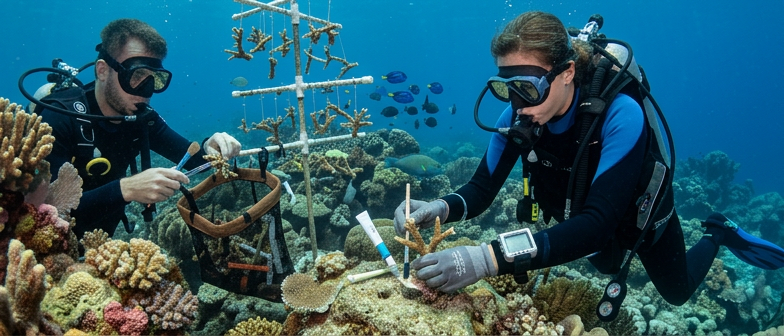
Underwater nurseries function like ocean gardens for reef builders. Small fragments are clipped from healthy donor colonies or collected from broken pieces, then suspended or attached to structures such as ropes, tables, or metal frames. Branching forms often thrive on floating rope systems where water flows freely around them, while heavier, more rounded species may rest on fixed tables or concrete supports.
In these ocean gardens, the focus is to keep conditions relatively stable, limit extra stress, and allow fragments to grow to a size that can handle life back on natural structures. Teams routinely clean algae and sponges from frames, inspect for disease or predators, and track growth and survival. Survival can be relatively high, turning a modest number of initial fragments into many potential habitat builders.
Land‑based systems add another level of control. Corals grow in tanks where light, temperature, and water quality can be carefully adjusted. This setting allows systematic testing of how different species or genetic families handle warmer water or other local stressors before they reach the open sea.
Once fragments reach a target size, they enter a field trial phase. Divers transport them to degraded patches and secure them onto rock or artificial bases using cement, epoxy, or specially designed frames and slabs. The goal is to evaluate which mixes of species, genotypes, and locations create a self‑sustaining community rather than a short‑lived planting.
Some projects favor material from naturally tough, heat‑tolerant colonies or from sites that already endure warmer conditions. Placing these “stronger” lines next to more sensitive ones in real‑world environments allows researchers to track which families continue to grow, reproduce, and build shelter for fishes and other organisms over time.
| Nursery setting | Main strengths | Typical trade‑offs |
|---|---|---|
| Ocean‑based structures | Natural flow, realistic light and temperature patterns | Less control over sudden events, more cleaning and maintenance |
| Land‑based tanks | Precise control of conditions and stress testing | Higher infrastructure needs, animals later adjust to open sea |
Choosing Places With a Future
Climate‑aware site selection
Picking locations for restoration is similar to choosing where to build a house: long‑term safety matters more than the most scenic view. Instead of focusing only on impressive coral cover or clear water, teams look at how temperature stress plays out over time.
Some areas warm quickly and experience repeated bleaching. Others still face hot periods but of shorter duration or lower intensity. Places that look similar on a map can have very different histories of heat exposure and recovery. For restoration, that means checking how often a site has bleached, how fast it has recovered, and how likely future spikes are based on broader climate patterns and local circulation.
Species and depth bring another layer of nuance. Colonies from wave‑exposed, tide‑washed zones sometimes show greater tolerance to temperature swings than those from sheltered lagoons. Different growth forms, such as branching, plate‑like, or massive structures, also respond differently to warming. The ideal site depends on which types are being restored and whether the local conditions match their strengths.
Turbid refuges and habitat trade‑offs
Cloudy, sediment‑rich water can sometimes act like a natural sunshade. Fine particles in the water column filter light and may soften the impact of extreme heat on shallow colonies. These turbid areas can, in some cases, avoid the most severe bleaching seen on nearby clear‑water reefs.
There are costs. Higher sediment loads can smother delicate species, and the composition of fishes and invertebrates may differ from that of clear‑water habitats. Nursery structures tend to attract a variety of reef residents, but the exact mix depends on depth, currents, and neighboring habitats. Managers weigh several questions at once: Are colonies likely to survive repeated heat events here? Will the restored patch support a diverse community? Is the site likely to remain protected from pollution or major physical disturbance?
Because budgets and staff time are limited, not every damaged area can be rebuilt. Climate‑aware planning directs efforts toward locations that have a reasonable chance of persisting, even if they are murky, less visually striking, or harder to reach.
| Site type | Potential advantages | Key considerations for planners |
|---|---|---|
| Clear, shallow reefs | High light, often attractive to visitors | May face intense heat and strong bleaching episodes |
| Turbid or deeper zones | Light buffering, sometimes fewer temperature peaks | Sediment stress, different community structure |
From Flat Surveys to 3D and 4D Views
Seeing the reef as a structure, not just a surface
For a long time, monitoring relied on simple measures such as how wide a colony was along a tape or what fraction of a straight line was covered by living tissue. These methods are useful but treat a reef as a flat drawing.
Three‑dimensional mapping adds depth. By turning coral heads and entire patches into digital shapes, researchers can estimate how much skeleton is present and where holes, ledges, and overhangs are changing. Comparing 3D models from different surveys reveals gains or losses in volume, not just shifts in surface cover.
This matters for restoration. A young outplanted colony may look small in standard photos yet add new skeletal material. Others may retain the same footprint but gradually hollow out and lose internal strength. In a 3D view, one area might clearly be rebuilding vertical complexity, while another flattens into smoother pavement that supports fewer hiding places and fewer species.
Adding time: 4D stories of damage and repair
Repeating those 3D surveys turns time into the fourth dimension. Matching models from different seasons or years builds a 4D sequence that tracks growth, breakage, and repair through repeated disturbances.
After a heatwave or powerful storm, 4D maps help identify which structures bounced back, which continued to erode, and where new growth concentrated. That highlights “recovery hubs” that may supply larvae to surrounding sites and “risk zones” where local stressors or repeated impacts keep blocking regrowth.
For teams planting nursery corals or trialing new support structures, 4D mapping shows whether added colonies are thickening the reef framework or merely surviving as scattered patches with little effect on overall complexity.
Q&A
-
How is modern Coral Reef Restoration Science different from older “plant and hope” approaches?
Modern projects integrate genetic screening, climate projections, and hydrodynamic modeling to decide which corals to propagate and where to place them. Restoration is now treated as an adaptive experiment, with explicit hypotheses, reference baselines, and feedback loops that continuously refine methods rather than assuming any transplant automatically improves reef health. -
What Reef Nursery Methods are emerging beyond basic ropes and tables?
New nurseries increasingly use modular, stackable frames, micro‑fragmentation techniques, and larval propagation mesocosms. Some teams deploy depth‑adjustable or mobile nurseries that can be raised during marine heatwaves. Others combine corals with engineered substrates hosting crustose coralline algae to chemically cue settlement and accelerate skeletal fusion among fragments. -
How do restoration projects support wider Marine Habitat Recovery, not just coral cover?
Well‑designed efforts focus on rebuilding habitat functions, such as fish refuge, carbonate production, and nutrient processing. Managers select coral mixes that create varied heights and crevices, coordinate with seagrass or mangrove work, and sometimes limit fishing or anchoring locally so recovering reef structure quickly translates into more resilient, multi‑species coastal ecosystems. -
Which tools are used to assess Ocean Temperature Stress and guide Biodiversity Protection Efforts?
Teams blend satellite sea‑surface temperature products, high‑resolution loggers on the reef, and thermal stress indices like Degree Heating Weeks. These data are overlaid with species‑specific thermal limits and connectivity models to prioritize protection for refugia, source reefs, and genetically unique populations that are most likely to seed future biodiversity across regions. -
What advanced Restoration Monitoring Tools are most useful in Coastal Science Research today?
Projects increasingly combine structure‑from‑motion photogrammetry, machine‑learning image classification, and acoustic sensors tracking fish activity. Environmental DNA sampling reveals cryptic species responses, while open‑source dashboards integrate growth, survival, and structural metrics so managers, scientists, and local communities can jointly evaluate success and adjust interventions in near real time.