
Rowing Machine Cardio Basics: Rhythm, Posture, and Joint-Friendly Endurance
Indoor rowing can be a joint‑friendly way to build heart and lung fitness while involving both upper and lower body. With a simple setup, an easy stroke pattern, and relaxed breathing, the movement becomes smoother and more sustainable. A few basic session structures then help beginners gain confidence without relying on high resistance or punishing effort.
This story is part of DailySeekers's practical reading library across everyday topics.
Setting Up the Rower So Your Body Feels Supported
Position, resistance, and handle setup
Comfort starts before the first pull on the handle. Adjust the footplates so the straps cross the broadest part of each foot, snug enough that your heels stay planted when you drive yet loose enough that your toes can move.
If your machine allows you to slide the footplates, aim for a position where your shins can come close to upright at the front of the stroke. This helps you reach the catch without your heels lifting too far or your knees collapsing inward.
Choose a moderate resistance. On air machines, a middle damper setting tends to feel smoother and less jarring than very high settings. On magnetic equipment, select a light to medium level where you can move steadily and still breathe in a relaxed, controlled way. It is easier to start lighter and build up once the stroke feels natural.
Set the screen close to eye height if you can, so you are not constantly looking down and rounding your neck. When you hold the handle, keep a gentle bend in the elbows, shoulders relaxed, and your spine long and neutral instead of slumped.
Joint‑friendly stroke cues
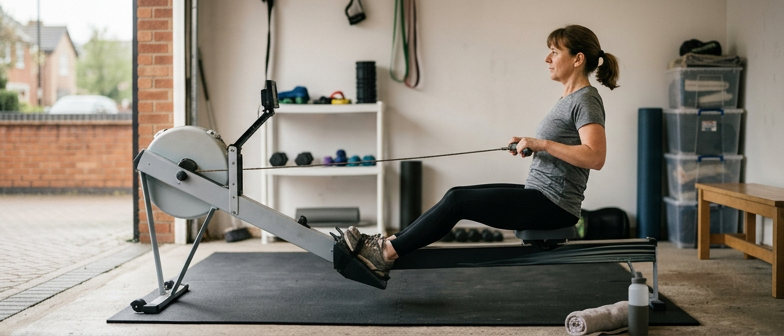
On the drive, think: legs first, then core, then arms. Push the seat away with your legs while your arms remain straight and your torso steady. As your legs approach straight, lean your body back slightly from the hips, then pull the handle in toward the lower ribs.
On the way back in, reverse the order: arms go straight, body tips forward from the hips, then the knees bend and the seat rolls smoothly toward the front. This “legs–body–arms” on the way out, “arms–body–legs” on the way in spreads the load across the lower body, mid‑section, and upper body instead of dumping it into the knees, low back, or shoulders.
Keep the stroke rate modest while learning. Fewer, smoother strokes give your joints and coordination time to adapt.
| Setup choice | Why it can feel better on joints |
|---|---|
| Mid‑range resistance | Allows smoother acceleration and deceleration each stroke |
| Shins near upright at front | Reduces awkward knee angles and hip compression |
| Screen close to eye level | Helps keep neck and upper back in a neutral position |
Understanding the Stroke Without Overthinking
Catch position: balanced, not tense
The catch is your starting shape, not a place to strain. Sit tall on the seat, with a neutral spine and eyes looking roughly forward. Let your shins come close to vertical, knees comfortably bent, and heels resting as near to the footplates as feels natural for your flexibility.
Keep your arms straight with soft elbows, shoulders loose, and chest gently lifted. The body leans forward slightly from the hips rather than rounding through the mid‑back. Imagine the handle resting lightly in your hands, more like holding a shopping bag than squeezing a heavy bar.
Before pushing, notice your breath. Taking a calm inhale at the catch helps you ease into the drive instead of yanking into it.
Drive, finish, and return as one loop
From that starting pose, start the drive by pressing through your feet and moving the seat back. Let your legs do most of the work while your arms stay straight and your torso steady. As the legs reach near straight, lean your body back a little from the hips, then draw the handle toward the lower ribs. This is the finish: legs long, core engaged, shoulders relaxed and down.
The return is like playing the movement in reverse. First, extend the arms so the handle moves away. Next, tip the body forward from the hips. Only then allow the knees to bend and the seat to slide forward. Slowing this part slightly often makes the whole stroke feel more controlled and less jarring.
Keeping a gentle pace and modest resistance while rehearsing this loop turns the movement into a smooth cycle rather than a series of separate steps.
Breathing, Rhythm, and Sustainable Effort
Linking breath and movement
Breathing rhythm is a simple way to organise the stroke. A common pattern is to inhale on the slide toward the front and exhale during the drive. The effort phase becomes linked with the out‑breath.
Think of each exhale as a quiet release rather than a sharp gasp. The chest stays open, shoulders loose, and the breath moves in time with the handle. As work level rises, try to keep the same pattern while allowing each breath to become slightly deeper or slightly quicker, rather than slipping into irregular panting.
Tight shoulders, a clenched jaw, or holding the breath usually signal that the breathing pattern has drifted. Returning attention to “inhale on the way in, exhale on the push” often settles things again.
Pace, stroke rate, and power sharing
A sustainable pace feels repeatable. You can hold it for several minutes without your stroke falling apart. The stroke rate stays roughly steady, and the numbers on the monitor change gradually rather than jumping wildly.
Aim for a level of effort where you could add a few more minutes if needed. That often means starting easier than you expect. Over time, what feels “easy‑steady” will naturally become faster as your technique and conditioning improve.
“Sharing the load” across the body is just as important as raw effort. On each drive, the legs provide the main push, the body swing adds a smooth follow‑through, and the arms finish the pull. The return is lighter: handle path straight, hands relaxed, seat gliding instead of bouncing.
| Focus area | Simple self‑check during a session |
|---|---|
| Breathing pattern | Can you keep inhale on the slide, exhale on the drive consistently? |
| Stroke rhythm | Does the drive feel firm and the return slightly softer and calmer? |
| Effort level | Could you continue for a few more minutes at this same quality? |
Session Ideas for Conditioning and Recovery
Gentle continuous pieces for everyday use
A light, continuous row can work well on days when you feel stiff, tired, or simply want a calm workout. Choose a pace where you can still talk in short sentences. The goal is a smooth, unhurried rhythm rather than big power.
Focus on long strokes: push with the legs first, keep the arms straight as the handle passes the knees, then lean back slightly and finish with the arms. Keep tension out of the grip and shoulders. Begin with a modest time that feels manageable and gradually add a few minutes as it becomes comfortable.
Because each stroke is low impact and well distributed across the body, this kind of session can gently train the heart and lungs while keeping joint stress modest. Many people find it fits well between harder workouts in other activities or on days when they prefer a restorative feel.
Short time blocks with easy rests
Breaking the work into short timed sections is another approachable option. One simple structure is to row several medium‑length pieces with generous easy rowing or full rest in between. Each work block should feel steady rather than all‑out, so you end each one feeling that you could have gone slightly longer.
These segmented sessions help you accumulate more total time on the machine without facing one long, mentally demanding stretch. The rests give you a chance to reset posture, revisit the “legs–body–arms” cue, and check in with how your back, hips, and knees are feeling.
Over multiple sessions, you can gradually add an extra work block, or gently reduce the length of the recoveries, as long as technique remains smooth and breathing reasonably controlled. Thinking of the machine as a place to practise relaxed, repeatable strokes—rather than a test of how hard you can pull—keeps the experience friendlier on the body.
Q&A
-
What are the key Rowing Machine Cardio Basics for beginners who want safe conditioning?
For beginners, focus on moderate duration pieces where you can still talk, a comfortable resistance, and a stroke rate that feels repeatable rather than frantic. Prioritise smooth breathing, even pressure through the feet, and consistent split times instead of chasing speed. Think of building cardiac “volume” before worrying about intensity or advanced metrics. -
How can Stroke Sequence Awareness actually improve both power and joint comfort?
Clear legs–body–arms coordination lets the big leg muscles start the drive, with trunk and arms adding layered force instead of yanking from the shoulders. This spreads load through hips and core, reducing knee shear and low‑back strain. Over time, better timing usually produces higher average pace at the same perceived effort and heart rate. -
Why is Steady Pace Training valuable for Low Impact Conditioning on the rower?
Steady pace rows create a predictable cardiovascular load while keeping joint forces relatively modest, ideal for cross‑training or returning from impact‑related niggles. Holding one pace for ten to twenty minutes teaches pacing discipline, refines breathing rhythm, and allows the connective tissues to adapt gradually without the spikes of sprint‑style intervals. -
How should I structure Time Based Intervals to balance fitness gains and technique quality?
Start with intervals like three to five minutes of rowing followed by one to two minutes of light paddling. Keep work segments at a conversational effort, focusing on posture control and consistent stroke length. As form and conditioning improve, you can extend the work blocks or slightly shorten recoveries while guarding against rushed strokes. -
What Posture Control Tips matter most during a Recovery Session Use day?
On lighter days, treat posture as the main training goal: sit tall from the hips, keep ribs stacked over the pelvis, and maintain relaxed shoulders with a quiet, neutral neck. Let the monitor pace be secondary. Gentle, technically clean strokes at low intensity help reset movement patterns and leave you feeling refreshed rather than depleted.