
Tennis Footwork Fundamentals: From Split Step Timing to Match-Ready Movement
Sharp strokes alone rarely decide a point; the way you arrive at the ball often matters more. Clean, quick steps help you react sooner, stay stable on contact, and recover for the next shot. With simple daily practice, any player can build smoother movement patterns across the court without changing their swing.
This story is part of DailySeekers's practical reading library across everyday topics.
How Lower-Body Preparation Shapes Every Rally
In many rallies, the real outcome is set a few steps before the swing. When the legs arrive late or stop too early, the ball feels faster, the contact point drifts, and the stroke looks like a “technical problem.” When the feet set up early, the same stroke feels smooth, even if the motion of the arm has not changed.
Good contact starts with how soon you recognize where the ball will land and how quickly your steps organize around that spot. A few small adjustment steps, a stable last step, and balanced weight at impact turn an average forehand into a confident one. The racket finishes work that your legs and hips already prepared.
Movement is also what buys you time and choices. When you are not fighting for balance, the mind stays clearer: there is space to choose direction and risk instead of just “getting it back.” Early preparation steps keep the body facing the right way and the eyes steady on the bounce, which helps timing.
Even between shots, gentle recovery steps pull you back toward a neutral court position rather than leaving you stranded in a corner. That neutral zone is where options open up again. Training these patterns means not only hitting balls, but also shadow swings with realistic steps, a small hop before every ball, and simple foot-speed work.
Ready Position and Adjustment Steps
A simple, repeatable ready position makes every other part of movement easier. It acts as a home base between shots, so your body always knows where to return.
Building a stable starting base
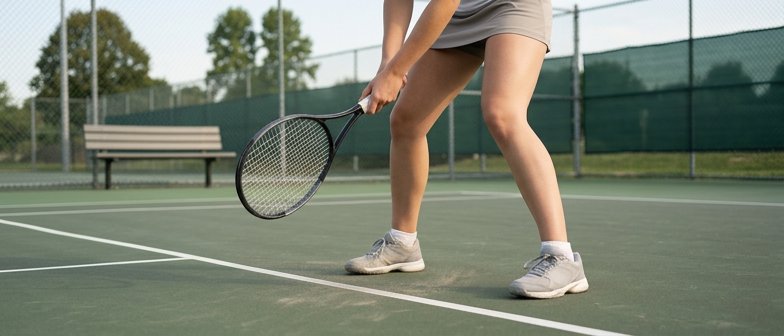
In an athletic base, the feet sit slightly wider than shoulder-width, knees are softly bent, and the upper body leans a little forward so the weight rests over the balls of the feet. The racket stays in front with relaxed arms and the chest facing the net, so any direction remains available.
The key detail is where your weight lives. A light, springy feeling under the toes lets you push without delay in or out, left or right. From that base, the goal is not to look busy, but to stay ready to move. Quiet, controlled posture keeps the head still, which improves tracking of the ball and makes it easier to judge distance and height.
Using small steps instead of lunges
Once the ball leaves the opponent’s strings, your job is to adjust without losing balance. A low, quick hop that lands as the opponent hits wakes up the legs and sets both feet down at once, ready to push off in any direction. From there, several short, quick steps usually place you better than one giant lunge.
Short steps help keep the hips under control, the head stable, and the racket path smooth. Big emergency strides may be necessary on very wide balls, but relying on them all the time often leads to off-balance swings.
“Arrive early, finish small” can guide this pattern. Use bigger movements to reach the general area of the ball, then finish with a cluster of tiny last steps to fine‑tune spacing. After contact, those same compact steps help you recover back toward a neutral spot.
| Movement choice | Typical result for the shot | When it helps most |
|---|---|---|
| Short, frequent steps | Better spacing and balance, smoother swing path | Standard rallies and moderate changes |
| Occasional long lunge | Emergency reach, but less control at impact | Wide balls when there is little time |
| No adjustment steps | Jammed or stretched contact, reduced shot options | Rarely useful except on very slow balls |
Turning the Split Step Into Real Speed
The small hop before the ball arrives is one of the simplest tools for faster reactions. Its value comes from timing, posture, and what you do in the instant after landing.
Why the tiny hop matters
That short off-the-ground moment is not just a habit; it is the on–off switch for movement. When both feet briefly leave the court, the leg muscles reset and then reload as you land. If the landing matches the opponent’s contact, your legs are ready to push almost instantly instead of reacting from a flat-footed position.
Staying on the balls of the feet keeps this “switch” half on. Soft knees, relaxed hips, and light heels allow a quick, low bounce rather than a high, heavy jump. If the hop is too big, you may land after the ball has already left the strings. If the timing is too early or too late, you may feel stuck.
Linking reading skills with the first step
As you rise to the top of the hop, your eyes should already be reading the racket path and likely direction of the ball. The instant your feet touch down, that reading turns into action. Often, one foot will land slightly earlier, opening the hip and doubling as your first move toward the ball rather than a separate step.
Thinking of “land and go” as one combined action helps. On the forehand side, the outside leg generally drives you diagonally toward the bounce rather than shuffling straight across. Short, quick steps complete the adjustment, then you hit and recover.
Simple patterns can reinforce this sequence: hop as the “opponent” hits, read the imagined direction, push off with the outside leg, move with compact steps, shadow a swing, then use recovery steps back to the starting spot. Repeating this hop–move–hit–recover rhythm, even without a ball, helps the body store it as an automatic response.
| Focus of drill | What it trains first | Typical practice example |
|---|---|---|
| Hop timing on contact | Faster initial reaction | Repeated small hops in sync with fed balls |
| First step direction | Explosive push with outside leg | Hop, then immediate diagonal drive to a cone |
| Full hop–move–recover cycle | Rally rhythm and court coverage | Shadow points with hop and recovery to center |
Warming Up and Micro-Drills for Everyday Practice
Movement improves most when it is woven into habits, not saved for occasional special workouts. Treating each hit as a chance to rehearse good steps turns warm‑up time and short breaks into useful practice.
A lower-body-focused warm-up
Before any balls come out, an athletic base with gentle hops can act as a mini movement session. Standing near the baseline, start in the familiar wide, soft‑kneed stance with weight on the balls of the feet. Add a low hop on every imagined “opponent hit,” aiming to land balanced and ready.
From there, layer in short patterns: a few small side steps to an imagined forehand contact point, plant the feet in a stable stance, then use compact steps to return to the middle. Repeat to the backhand side. The focus stays on smooth rhythm and spacing.
This kind of warm‑up gently raises the heart rate, but its real value is teaching the body where to place the feet for common shots and how to recover afterward.
Short routines that fit anywhere
Once these patterns feel natural, they can be split into micro‑drills that fit into existing sessions without needing extra time. Between rallies, a short burst of quick recovery steps from one corner back to a neutral position can reinforce good habits. While picking up balls, you can slide out to one side, set the feet in balance as if preparing to hit, then push off and “reset” your stance before bending down.
A simple pattern many players enjoy is “two steps out, two steps in” from different spots: near the baseline to mimic lateral coverage, and slightly inside the court to mimic moving forward. Each repetition finishes in a strong base with clear, deliberate recovery.
These routines are useful for developing players who are still learning to coordinate their bodies, and they also help experienced players keep their lower‑body patterns sharp. Over time, they encourage earlier preparation, calmer balance on contact, and smoother coverage of the court, all without needing complex equipment or long additional sessions.
Q&A
-
How do Tennis Footwork Fundamentals influence stroke consistency and power?
Solid footwork fundamentals create a stable hitting base, letting you transfer force from the ground through your hips into the racket instead of muscling the ball with your arm. When your feet arrive early and in balance, you can swing more freely, repeat your contact point, and adjust to different ball heights without overworking your technique. -
What are effective Court Movement Drills for recreational players with limited time?
For time‑pressed players, simple cone patterns are ideal: figure‑eight runs around two cones near each sideline, baseline “L” runs combining forward and lateral moves, and diagonal sprints from center to corners. Keep work blocks short, twenty to thirty seconds, with active rest, focusing on clean steps, posture, and quick recovery to the middle. -
How can Balance Improvement Work be built into regular hitting sessions?
Rather than adding long workouts, use constraints during rallies: hit mini cross‑court points where you must hold your finish for two seconds, or rally while standing on slightly narrower bases to challenge stability. Light single‑leg landings after shadow swings or split steps also train balance while mimicking real patterns you will use in matches. -
What cues help refine Split Step Timing and Direction Change Practice together?
Link a visual cue with a verbal one: say “up” as your opponent prepares to strike, then “down” as racket meets ball so your split lands on contact. Immediately commit your first step in the read direction, avoiding hesitations. Combine this with cone targets so every timed split flows into a sharp change of direction and quick recovery. -
Which Agility Routine Basics support long‑term Match Readiness Habits?
Short, repeatable routines work best: ladder drills for quick feet, baseline shuttle runs for endurance, and diagonal start‑stop sprints for change of pace. Schedule them two to three times weekly, five to ten minutes each, and pair every routine with deliberate cool‑downs and hydration so your body associates agility work with sustainable, match‑ready preparation.