
Reading the Climate in the Graphs: Turning Temperature Lines and Rainfall Maps into Insight
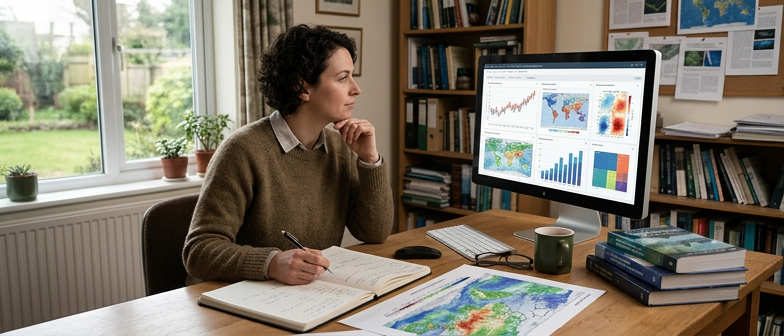
Lines on a chart and colored world maps can seem intimidating, yet they quietly hold powerful stories about shifting seasons, rising heat, and changing rain. With a few simple habits, anyone can start noticing patterns, asking better questions, and drawing clearer meaning from everyday graphics that deal with the air, water, soil, and sky.
This story is part of DailySeekers's practical reading library across everyday topics.
Seeing the Story in the Squiggles
Spotting the big picture first
Graphs that track the planet often look like a tangle of lines, dots, and shaded bands. A quick way to calm the noise is to ask three questions: what is changing, how fast, and where.
A line that climbs steadily over many points usually hints at a long‑term shift rather than a single bad year. A curve that dips and rises sharply is more likely to reflect short‑term swings. Looking for the overall direction first helps keep those wobbles in perspective.
Maps covered in color patches work much the same way. Large areas shaded in similar tones point to broad patterns, such as warmer seas in one part of an ocean or several nearby regions facing repeated dry spells. Small streaks or blobs of intense color often point to local extremes or unusual events. Let your eyes find the large patches and clusters before zooming in on individual spots.
A useful habit is to pause on three elements before reacting to any graph or map:
| What to check first | Why it helps your reading |
|---|---|
| The legend and units | Clarifies what each line, dot, or color stands for. |
| The time span | Shows whether you are looking at short‑term swings or long‑term shifts. |
| The geographic coverage | Helps you judge whether a pattern is local, regional, or widespread. |
Reading patterns like a story
Treat each graphic as a story with a cast of characters: baseline, trend, and anomaly.
The baseline is the “normal” reference, often drawn as a flat line or a shaded band. Values that sit close to this reference describe background behavior. A slowly rising or falling curve is the main plot, hinting at where things are heading over many seasons or years. Sudden jumps that leap outside the usual range are plot twists. They can be dramatic, but they are not the whole story on their own.
Creative map projects and research visuals sometimes rearrange shapes, stretch land areas, or alter familiar outlines to reveal hidden structure. When a familiar shape is redrawn, the message is rarely that everything flipped overnight. More often, it is an attempt to show what was already happening in a clearer way. By looking first for the baseline, the overall slope, and the biggest departures, those squiggly lines start to read like a grounded narrative about how conditions are shifting.
From Dots and Colors to Patterns and Trends
Turning scattered marks into a clear picture
Images built from dots, pixels, and small symbols can feel confusing. To turn them into a clearer picture, it helps to walk through three questions: what, where, and when.
What does each mark represent? One dot might stand for a measuring station on land, one patch for a satellite reading over the sea, or one line for a computer‑generated run. The legend is the key that unlocks this code.
Where are the changes happening? On a map of warmth, rain, snow, or plant growth, clusters of similar colors or symbols usually carry more weight than a single bright speck. Broad areas sharing a common shade say more about the overall system than one eye‑catching point that might be a local quirk, an unusual event, or a data issue.
When was the information collected? Long records reveal slower shifts in the background, while short slices often highlight day‑to‑day or year‑to‑year ups and downs. Knowing the length of the record helps keep emotions and expectations in check.
Looking past the wiggles
Once the basic “what, where, and when” are clear, the next step is to look past individual ups and downs and hunt for patterns.
On a line chart, focus first on the broad direction. Do measures linked to heat, growing seasons, or ice cover drift upward or downward over many points, even if they wobble? That underlying drift reflects the slower reshaping of the system rather than short bursts of unusual weather.
On seasonal charts that stack many years or periods together, it helps to compare groups instead of single curves. If more recent warm‑season lines tend to cluster above older ones, that can hint at added heat stress. If the shaded band that marks typical variation grows wider, that can point toward more erratic conditions from one season to the next.
For sequences of maps made from satellite‑style views of plant “greenness” or snow cover, try reading them like a time‑lapse. Do green areas gradually fade or expand? Do snowy regions shrink, shift, or break up over time? Paired with graphs, these visual series turn isolated dots and color patches into a more complete picture of how land, water, and air are evolving together.
Common Traps and How to Avoid Being Misled
Hidden choices in axes and scales
Many graphics look objective at first glance, but small design choices can change the whole impression.
One major trap lies in the vertical axis. If the scale does not start at zero, a modest rise can look like a wall. If the range is extremely wide, meaningful shifts may appear almost flat. Before forming an opinion, it helps to check where the axis starts, how far it runs, and what units are used.
Time scales can be just as tricky. A very short time window can hide slower warming or exaggerate a brief pause. Because broad‑scale patterns usually play out over long stretches, a handful of years rarely tells the full story. Graphics that span longer periods, or that show fine‑scale detail against a longer backdrop, tend to offer a more reliable view.
Another subtle trap is the choice of color scale. Strong reds and deep blues can make small differences look dramatic, while pale tones can mute sharp contrasts. If the meaning of the colors is not clear, or if the range feels extreme, it is wise to dig into the legend and any notes on how the scale was set.
| Design choice to notice | Possible effect on the message |
|---|---|
| Cropped vertical axis | Can exaggerate small differences between lines or bars. |
| Very wide value range | Can hide meaningful shifts by making lines look almost flat. |
| Aggressive color contrast | Can make modest departures look like sharp breaks from normal. |
Missing context, uncertainty, and sources
Another common issue is a chart that shows a crisp line but hides how that line was created. Information about air, oceans, ice, and land often comes from a mix of instruments, sampling, and computational methods that involve some estimation. Clear visuals mention where the information came from and, when space allows, at least a hint of how it was processed. Without that context, it becomes hard to judge whether gaps between lines or bars are important.
Shaded bands or notes about limits and uncertainty may look messy, but they protect readers from false certainty. Thin, sharp curves with no hint of spread can imply that the future is known exactly. Simple designs such as plain stripes or basic line charts work best when they also admit what is not known, not just what has been estimated.
When those elements are missing, a cautious response is healthy. Instead of accepting or rejecting the graphic outright, it helps to ask: what choices were made, what might be left out, and how might that affect my reading of the picture?
Turning What You See Into Better Questions
Letting simple images do the talking
The most effective images are often the simplest. A line moving steadily upward or downward, a color that grows darker over time, or a map shading more regions than before can all be understood without special training.
Interactive tools add another layer by tying those shifts to places people know. A viewer might zoom in on a familiar shoreline, move a slider that raises or lowers water, and watch how certain streets, homes, or fields slip from dry to flooded. That moment when a map changes from light to dark over a known spot can be more powerful than any block of text, because it links abstract quantities to daily life.
The important step is not the tool itself but the questions it sparks. When images are clear and grounded, they make it easier for people to reflect on routes, buildings, parks, or farmland they care about, and to think through which changes might be manageable and which might require planning.
Turning reactions into useful questions
The first reaction to a map or graph about heat, storms, or shifting ecological zones is often emotional: surprise, concern, or doubt. Rather than stopping there, it helps to turn those feelings into specific, checkable questions.
Looking at a chart or map, a viewer might ask:
- “Is this pattern new, or has something similar happened before?”
- “How large is this change compared with other regions or previous periods?”
- “Does more than one source show a similar pattern, or is this result standing alone?”
- “What kind of uncertainty or data gaps might affect this picture?”
These questions do not require specialist knowledge. They simply ask the graphic to tell a fuller story. In group settings, shared visuals can support careful discussion. When a graph or map is visible to everyone, people tend to point at particular features and ask, “What is going on here?” or “Why does this area look so different?”
Over time, returning to these basic questions builds a habit. Instead of treating these images as distant or overwhelming, people begin to use them as tools: not just to witness change on a screen, but to think through what that change might mean for health, safety, food, transport, and planning in places they know well.
Q&A
-
How can Climate Data Visualization help non‑experts gain Environmental Insight using simple graphs and maps?
Climate data visualization turns complex measurements into shapes, colors, and motions that mirror everyday experience, such as warmer summers or shifting rainfall seasons. When visuals emphasize clear legends, intuitive color scales, and recognizable places, they act as environmental insight tools, helping non‑experts connect abstract metrics with local memories, choices, and risks. -
What Graph Reading Skills matter most for understanding Temperature Trend Mapping in everyday media?
Key skills include spotting the long‑term slope rather than fixating on short wiggles, checking the time span, and noticing whether axes start near zero or crop extremes. Readers should also compare multiple locations or baselines, because seeing parallel warming trends across regions is stronger evidence than reacting to a single dramatic curve. -
How do Rainfall Pattern Displays support better Public Science Communication about droughts and floods?
Rainfall pattern displays reveal not only totals but timing, intensity, and spatial clustering of wet and dry periods. Communicators can pair these visuals with local examples of water restrictions, crop impacts, or flood planning so audiences see how changing patterns translate into real decisions, rather than treating maps as distant or purely technical artifacts. -
What are some Data Storytelling Basics for turning raw climate charts into engaging explanations?
Effective storytelling highlights a relatable baseline, the main trend, and a few meaningful anomalies, then links them to lived experience. Short, focused captions explain why the pattern matters now and in coming decades. Avoiding jargon, acknowledging uncertainty, and inviting questions helps audiences feel included rather than lectured or overwhelmed. -
How can Environmental Insight Tools be used in classrooms or community meetings to build critical thinking?
Interactive dashboards, time‑lapse maps, and simple comparison charts can anchor group discussions where participants propose explanations, check alternative data sets, and debate possible responses. Facilitators can guide people to question scales, sources, and assumptions, turning passive viewing into shared inquiry and building long‑term confidence in reading climate information.