
Moon Phases Made Visible: From Simple Night Notes to Tides and Sky Patterns
On any clear evening, our nearest celestial neighbor offers a quiet experiment in patience and curiosity. Its shape shifts, its path leans along the horizon, and coastal waters seem to respond in turn. With nightly notes, even newcomers can uncover a repeating rhythm that ties together sky, shoreline, and the passing of days.
This story is part of DailySeekers's practical reading library across everyday topics.
Learning the Moon’s Changing Shape in the Evening Sky
Large shifts that stand out quickly
On a clear night, the simplest thing to notice is how much of the surface is bright. Some nights it is a thin slice, other nights a glowing circle, and sometimes it seems to vanish into the background.
When it appears “missing,” it is close to the dark phase, with the sunlit side turned away. You are mostly seeing the night side, and the glow of the sky hides it. A few evenings later, a slim crescent appears low in the western sky after sunset, with its rounded edge facing roughly toward where the Sun went down.
Roughly a quarter of a cycle after the dark phase, the disk looks half lit. As the nights pass, the bright part grows into a thicker shape, often called gibbous, heading toward the familiar round face.
Near the brightest stage, the face looks almost like a complete circle. It tends to rise around the time the Sun is going down and to set near sunrise, so it is in the sky for much of the night and is hard to miss.
Smaller clues that sharpen your eye
After the bright round stage, the lit area starts to shrink. This is the waning stretch of the cycle. A waning gibbous rises later in the evening, the next quarter again looks half lit, and a slender waning crescent shows up before sunrise in the eastern sky.
Three simple checks help put each night in context:
- How much of the disk is bright?
- Which side is lit?
- When do you first notice it: evening, late night, or before dawn?
If the bright part is growing and you usually see it in the evening, it is waxing. If it is shrinking and you mostly catch it late at night or toward dawn, it is waning. Over a few weeks, these checks make the sequence feel familiar when the pattern restarts.
Building a Simple Night Notebook
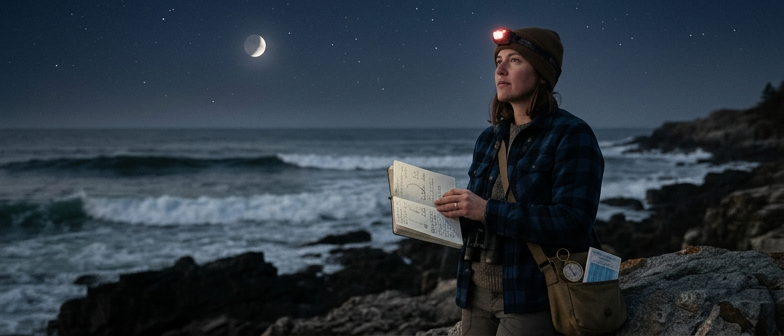
A notebook for following the sky does not need special pages or equipment. A small pad and a spot with an open view are enough. On each entry, leave space for three key details: shape, time, and place.
For shape, make a fast sketch. Drawing skill does not matter. A rough circle with the lit part shaded or outlined is enough to mark “thin crescent,” “half,” “gibbous,” or “almost full.” Over about one full cycle, those quick drawings form a repeating pattern.
For time, note the date and the clock time. Adding a short hint such as “early evening,” “late night,” or “before sunrise” helps you see when the Moon tends to appear at different stages.
For place, write where you are and where you see it in the sky: “from the backyard, low in the west,” or “above the trees in the east.” After several entries, this builds a picture of how its path shifts.
Pairing paper notes with basic tools
Some people like to pair their notebook with a simple printed calendar or a basic app that shows a small preview for each day. This can help you plan when to look for a thin crescent or a bright full disk, and then compare the predicted shape with your own sketch.
A small calendar that lists bright stages can also help. The listed moment marks when the Moon is exactly at that phase, even if clouds or daylight keep it hidden. Writing that moment into your notebook and then noting when you actually see it rise or set teaches the difference between the exact phase and your personal viewing time.
Regular notes on clear nights turn a plain notebook into a map of shape, time, and place. Over a few cycles, these notes reveal how the path in the sky repeats in a steady rhythm.
Simple ways to keep notes organized
A basic table on a loose page can make these logs easier to scan:
| Entry type | What to write or draw | How it helps over time |
|---|---|---|
| Shape sketch | Simple circle with lit side marked | Shows the repeating order of visible phases |
| Time of viewing | Clock time plus “evening,” “late,” or “pre‑dawn” | Reveals how appearance time shifts each night |
| Position in sky | “Low/high” and direction such as east, south, or west | Highlights the slow drift along the horizon |
Even with only a few rows filled in, patterns in your own notes become easier to spot.
Turning Scattered Notes into Recognizable Patterns
Reading your own observations like a story
A way to uncover the Moon’s rhythm is to read past notes in order. Put the basic details in a single column: date, time, position, shape, and overall brightness.
After a while, certain clues stand out:
- The shape changes in a steady, repeating sequence.
- The time you first notice it shifts later or earlier from one night to the next.
- Its position at the same clock time slides along the horizon and climbs to different heights.
Instead of trying to memorize a full cycle, compare today’s note with one from roughly one cycle earlier. If the shape, viewing time, and direction feel familiar, you are likely seeing a similar point in the repeating pattern.
Drawing a simple pattern chart
A hand‑drawn chart can turn scattered notes into a clear picture. Use a row for each day you observed and a few columns for time, height in the sky, and a quick sketch.
Some trends may emerge:
- Similar shapes reappear at roughly regular intervals.
- Full‑looking sketches line up in a loose vertical band.
- Crescent sketches cluster into two groups: one after sunset, and another before sunrise.
Over several cycles, these clusters become predictable landmarks. Your notebook starts to feel like a map of a path that loops in a steady way across the sky.
A small comparison table can make sense of the main contrast between waxing and waning stages:
| Stage of change | When you usually see it | Typical look in the notebook |
|---|---|---|
| Waxing | More often in the evening and early night | Bright part growing, rising time shifting later |
| Waning | More often late at night or pre‑dawn | Bright part shrinking, appearance time earlier |
Seeing the Same Rhythm at the Coast
Stand on a beach for a few hours and the pull of the Moon is hard to sense directly. Watch the shoreline over several days, though, and a connection with the sky becomes easier to notice.
Around the darker and brighter ends of the cycle, high waters tend to climb farther up the shore and low waters often fall lower than average. These periods are commonly called spring tides, not because of the season, but because the water appears to “spring” farther in and out. During these stages, the Sun, Earth, and Moon line up, so their gravity pulls in roughly the same line and the tidal range grows.
About halfway between these points, near the quarter phases, the difference between high and low water is usually more modest. These are neap tides. The Moon and Sun pull at roughly right angles, so their effects partly cancel out and the rise and fall seem gentler.
For anyone who enjoys walking tidal flats, looking into rock pools, or planning a coastal photo session, matching a basic phase calendar to local tide tables can be useful. Close to the dark phase, nights are deeper because the sunlit side faces away, and the same stretch brings a run of larger spring tides. Around the bright round phase, the Moon can cast sharp shadows on wet sand, and the tidal range again tends to be near its peak.
Local coastline shape, wind, and air pressure still play important roles, so the phase is more of a guide than a guarantee. Used alongside local tide information, the Moon’s steady rhythm helps explain why some days the sea creeps in quietly, while on others it climbs the beach with greater reach, echoing the changes you have been tracing in your sky journal.
Q&A
-
How can a Moon Phase Observation Guide help a complete beginner start Astronomy For Beginners at home?
A simple Moon Phase Observation Guide gives you a nightly target, basic sketches of shapes to compare with, and tips on when to look. By matching what you see to the guide, you quickly learn Lunar Cycle Basics without needing a telescope, turning casual glances into structured Night Sky Tracking. -
What are the key Lunar Cycle Basics that support better Night Sky Tracking and Pattern Recognition Skills?
Important Lunar Cycle Basics include the approximate 29.5‑day length, the repeating order of phases, and the link between phase and time of rise or set. Once you know this framework, every brief look outside strengthens Pattern Recognition Skills, because you can instantly place tonight’s view within that repeating cycle. -
How does keeping a Simple Observation Journal actually improve Pattern Recognition Skills over time?
A Simple Observation Journal forces you to record details that your memory would blur: shape, time, direction, and brightness. When you re‑read entries, repeated combinations jump out, training Pattern Recognition Skills. You begin anticipating what comes next in the Night Sky Tracking sequence, which builds quiet confidence. -
In what ways does Tidal Relationship Awareness deepen an Astronomy For Beginners practice beyond just looking up?
Tidal Relationship Awareness connects sky notes with changes at beaches, estuaries, and harbors. Matching phases to local tide tables shows how Lunar Cycle Basics play out in real water levels. This link between Moon positions and coastal behavior turns abstract astronomy into something you can verify while walking along shorelines. -
How can someone in an English‑speaking country design a practical Moon Phase Observation Guide tailored to local conditions?
Start with a Simple Observation Journal, then add a printed calendar listing phases in local time and a tide table for the nearest coast. Note typical weather and daylight patterns for your latitude. Over a few months, refine the guide with your own best viewing times, becoming a personalized Night Sky Tracking toolkit.