
Small Alignment Shifts, Big Daily Relief: Posture Tips That Actually Fit Your Routine
Hours at a screen can quietly reshape how your body stacks itself, leaving you stiff, tired, or sore by evening. Comfort usually comes from small, repeatable choices. Subtle shifts in how you sit, stand, and walk between everyday tasks can gradually ease strain and help your body share the workload more evenly.
This story is part of DailySeekers's practical reading library across everyday topics.
Noticing What Your Body Really Does All Day
Quick reality checks in everyday spots
The way your body feels is shaped by the positions it repeats without a second thought. Trying to “hold perfect form” all day is exhausting; noticing what you already do on autopilot is usually more useful.
Start with the place you sit the most. Before you change anything, settle into your usual shape in the chair. Then scan:
- Where are your feet: tucked under, stretched forward, or flat on the floor?
- How much of the seat is actually under you: just the edge, or your whole seat?
- Where is your head: stacked over your chest or reaching toward a screen?
Many people discover a pattern of hips sliding forward, feet drifting away from solid contact, and the head reaching out. That pattern alone is helpful information.
A wall can offer a simple snapshot. Stand with your back to it and see what meets the surface comfortably: heels, hips, upper back, and maybe the back of your head. If your head floats forward, treat that as a calm data point.
Daily “micro-moments” also reveal a lot. Notice how you stand when you unlock your phone, wait in line, or lean on the kitchen counter. Do you sink into one hip, round the shoulders, or let the chest collapse while scrolling? Each small moment seems harmless, but repeated all day, it shapes your usual form.
Your eyes and feet make good guides. If a screen sits low, your gaze pulls the head down. Lifting it closer to eye height can let the neck settle into a more neutral stack. When sitting or standing, check occasionally that your feet are planted and pointing roughly forward.
Short movement breaks act as gentle resets. Standing up, reaching overhead, rolling the shoulders, or taking a few steps brings you back into contact with how your body naturally re-forms itself.
When a brief reset is most helpful
Some everyday moments are especially useful for these check-ins. Without adding new tasks, you can tack a tiny scan of your body onto routines you already have.
| Situation in the day | Simple body check that fits naturally | Why it helps as a cue |
|---|---|---|
| Unlocking a phone or tablet | Notice if your head is jutting forward; gently draw your chin back and let your shoulders soften | Screens are frequent; pairing them with a soft reset adds many mini-practice rounds |
| Waiting in line or at a counter | Check whether you are hanging on one hip; shift to share weight between both feet | Standing time becomes practice for more even loading through the legs and spine |
| Sitting down to work again after a break | Plant your feet, slide back in the chair, and let your backrest take some of the load | Each return to the chair becomes a chance to re-set your base rather than sliding into a slump |
Over time, these low-effort cues can shift your “default” without feeling like a demanding routine.
Small Adjustments At a Desk That You Can Actually Keep Up
Chair shifts that feel natural
Changing how you sit does not need special equipment. Starting with the chair often creates the biggest difference with the least effort.
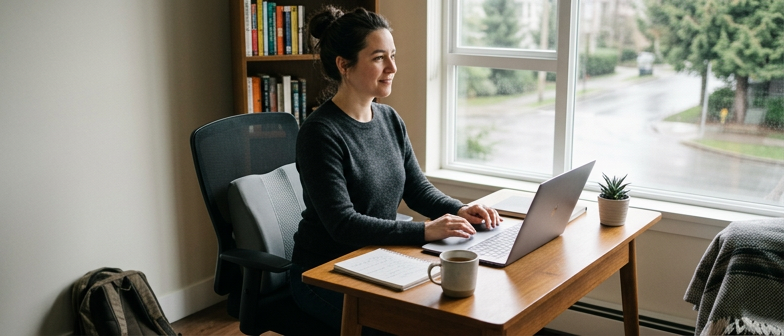
Sit all the way back so the backrest can support the gentle curve of your lower back. Perching on the edge leaves your spine doing more of the work. Adjust the height so your feet rest flat; if they dangle, placing them on something stable lets your knees and hips bend comfortably.
Allow your shoulders to drop instead of trying to pin them back. Forcing a rigid pose usually creates tension in the neck and upper back. Adjust armrests so your elbows sit near your sides and roughly level with the desk.
From time to time, run through a simple checklist: feet grounded, knees close to the same height as the hips, back supported, shoulders soft. This quick scan can gently redirect you if you have drifted into a slump.
Bringing your work closer instead of leaning in
Once the base feels steady, shift attention to what you look at and reach toward. If your screens and tools stay far away or too low, your body will keep chasing them.
Position the main screen so the top edge sits roughly around eye level, with the center a bit lower. When using a portable computer, raising it on a stable surface and adding a separate keyboard and mouse when possible can reduce the urge to crane your neck.
Place the keyboard close enough that your elbows remain near your body with a comfortable bend. Wrists can feel straight and level instead of lifting up or dropping down. Keeping a pointing device beside the keyboard rather than far out to the side helps your shoulder avoid long, repeated reaches.
A periodic glance at your setup—perhaps when you take a sip of water or finish a message—can remind you to slide the keyboard closer, center the monitor, or nudge your chair back under the desk.
Standing And Walking With Less Effort, Not More Tension
Letting the ground share the work
When you stand still to chat, pay, or wait, the way your feet meet the floor shapes the rest of your body.
Think about “wide and quiet” feet: about hip-width apart with toes mostly forward. Notice whether you sink into one hip or rest heavily on one leg. Explore sharing your weight between both sides.
Spread your weight through the full footprint of each foot: heel, inner ball, and outer ball. If you feel glued only to your heels, soften the knees slightly and allow some weight to roll toward the front. This soft, springy stance can feel less tiring than standing with rigid, locked joints.
From the ground up, imagine your ankles, knees, and hips stacked in a relaxed column. Knees are not jammed straight; hips are resting rather than pushed forward. Let your ribs float over the pelvis instead of thrusting out. This quieter alignment gives different joints a chance to help instead of leaving one area, such as the lower back, doing most of the work.
Gentle cues while you walk
Keeping the same sense of even contact through your feet while walking can encourage smoother motion.
Allow the weight to flow from heel to toe instead of landing with a heavy stomp or shuffling. Imagine your head lightly floating above the spine, with your gaze directed ahead instead of locked on the ground.
Let the chest remain open without exaggerating it, as if someone is gently lifting the back of your collar, encouraging a tall but relaxed shape. If your shoulders creep upward, imagine them melting down and away from your ears.
Small questions at intervals can guide these changes: Are my ribs sitting over my pelvis? Am I clenching my jaw, fists, or glutes? Loosening any area that feels overly tight and letting your arms swing naturally can allow your joints to cooperate instead of bracing.
Creating A Repeatable Daily Rhythm
Making tiny checks part of the background
Lasting change often comes from actions that are easy enough to repeat on busy days. Rather than aiming to hold one fixed position, you can think in terms of frequent, light resets.
Every half hour or so, pause briefly. Look away from the screen, place your feet flat, imagine growing taller through the crown of your head, and lightly roll your shoulders back and down. Take a few slower breaths.
At first, quiet reminders on a device or calendar can cue these check-ins. Over time, specific events—opening an email app, standing to refill a glass, finishing a call—can become the prompt. The aim is not perfection; the goal is to interrupt long periods in one position, which are often what lead to stiffness and fatigue.
Blending light strength work with short movement breaks
Many people find it easier to support more comfortable alignment when simple strength work and movement breaks are woven into the same brief routine.
A small loop can look like this: one quick reset, one or two easy exercises, then a short walk or stretch. Moves that fit into a chair work well: gentle leg lifts, slow torso twists, or relaxed arm raises. These can nudge the core, hips, and upper back to wake up without turning the break into a workout.
During the day, you can add standing exercises that ask the shoulders and midsection to help, such as sliding your arms up and down a wall or lightly pulling a band apart at chest height. Pairing these with a short walk down a hallway or a few calm stretches creates a rhythm that feels doable even when schedules are tight.
The most important part is consistency, not intensity. If a pattern is light enough that you are willing to repeat it on a tiring day, it has a better chance of becoming automatic. Over weeks of these almost unremarkable resets, your regular way of sitting, standing, and moving can slowly shift toward shapes that feel less strained and more sustainable.
| Daily pattern style | Typical benefits | Possible challenges |
|---|---|---|
| Single long session of exercises | May build strength and mobility in one block of time | Easier to skip on busy days; changes in day-to-day comfort may feel slower |
| Several short reset loops | Interrupts long static positions, can be done at a desk or at home | Requires gentle planning and reminders until the habit settles in |
| Blended approach (one longer block plus mini-breaks) | Combines focused practice with frequent small adjustments in real-life positions | Needs some experimentation to find a balance that feels realistic |
Q&A
-
How can I use simple posture improvement tips without overthinking every movement?
Choose one or two easy anchors during the day, such as feeling both feet on the floor and letting your shoulders soften away from your ears. Return to these anchors whenever you notice discomfort, instead of chasing a perfect pose. This keeps posture change practical and less mentally draining. -
What does good desk sitting alignment actually feel like, not just look like?
Comfortable alignment usually feels supported rather than upright and rigid. Your pelvis is back in the chair, feet flat, and ribs stacked over the hips with the chair carrying much of the load. Your arms rest close to your sides, and you can breathe easily and turn your head without strain. -
How can standing position awareness prevent end‑of‑day fatigue?
When standing, quietly scan whether your weight is dumped into one hip, knees locked, or toes gripping. Shifting to evenly loaded feet with soft knees and relaxed hips lets larger muscle groups share the work. This reduces localized fatigue in the low back, calves, and neck over long days. -
What core support habits matter most for neck strain reduction?
Focus on gentle, low‑effort engagement around the lower ribs and abdomen, especially when you reach or look down. Supporting from the middle keeps the head from jutting forward and the shoulders from doing all the work. Light breathing‑friendly activation often protects the neck better than bracing hard. -
How can I design a movement break routine that improves everyday body mechanics?
Build very short breaks around real tasks: stand up after finishing an email, walk during calls, or add two slow squats after refilling water. Include one spine movement, one hip or ankle movement, and one reach overhead. Over time, these small patterns transfer directly into easier walking, lifting, and bending.