
Volleyball Practice Fundamentals: Turning Passing Reps and Serve Targets into a Smart Team Session
A calm training space does not appear by accident. It grows from small, repeatable habits: how players walk onto the court, how the first ball is touched, and how often voices stay clear instead of rushed. When those details are planned, sessions feel less chaotic and more like the rhythm of real competition.
This story is part of DailySeekers's practical reading library across everyday topics.
Setting the Tone Before the First Serve
Quiet warm-up habits that calm the court
The first few minutes on the court decide more than most players realize. People arrive with busy minds and stiff bodies. Simple, low‑key routines help everyone shift into a training mindset. Light jogging, steady breathing, and controlled movement send a clear signal: focus is rising, but panic is not welcome.
Dynamic movements work when they stay clean and balanced. Side shuffles, hip circles, lunges, and arm swings can all stay small and precise. The goal is to wake up joints and muscles without rushing. When athletes sit lower in their stance and move smoothly, they look ready to move in any direction.
This warm‑up also sets an emotional tone. Keeping voices calm and instructions short avoids early noise and confusion. Instead of shouting, coaches and leaders use clear, firm cues. Over time, players associate these first minutes with a mental reset that prepares them for more demanding drills.
Turning early ball touches into focused work
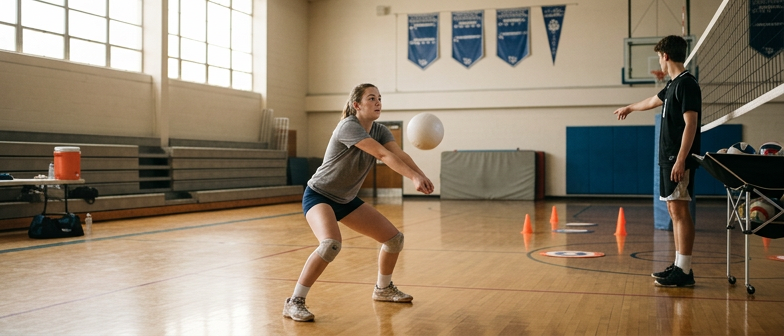
Once bodies feel ready, the ball comes out—but intensity stays controlled. Partner work at a close distance is enough to start. Each contact highlights a clean platform, soft touch, and steady feet. The ball does not need to move fast; it needs to move predictably. Repeating simple patterns creates dependable habits.
Progressions can stay gentle while still feeling like play. Passing into a set and then a tossed tip, rather than a full swing, lets players practice reading the ball and adjusting their feet without heavy impact. Landings stay soft, knees bent, and balance centered.
Small games can appear later in this phase, but the structure should remain familiar: similar order each day, clear rules, and calm corrections. That consistency keeps nerves low and attention high. Gradually, these routines turn the start of practice into a reliable reset button.
Making First Contact More Reliable Under Pressure
A stable, repeatable first touch shapes every rally. When the body position and platform are consistent, passers spend less energy reacting in panic and more energy making small adjustments.
Building a stable base and platform
A strong base starts from the ground. Feet sit a bit wider than shoulder width, with weight forward on the balls of the feet. Hips stay low so movement in any direction feels easy. This stance removes much of the chaos because the body is already prepared to move.
From there, the platform needs to act like one smooth surface. Wrists lock, thumbs stay together, and elbows do not bend at impact. Holding the finish after contact—pausing for a second to see exactly where the platform points—gives instant feedback. If the arms point toward the target, the contact likely helped the team. If not, players can adjust before the next ball.
Short, focused rounds support this learning. One server, one passer, and a single target keep choices small. Instead of chasing more and more balls, players repeat a limited number of reps with attention on stance, angle, and distance. The aim is not volume; it is sameness under different balls.
Here, a simple decision guide can help players notice what to adjust:
| Situation at contact | Useful adjustment focus | Why it matters |
|---|---|---|
| Ball flies too far sideways | Change shoulder angle | Small angle shifts control direction |
| Ball dies short of target | Add more lift from the legs | Using legs, not arms, keeps platform stable |
| Contact feels rushed or jammed | Start deeper or earlier movement | Extra space gives room to extend the platform |
| Platform breaks after contact | Lock wrists and straighten elbows | A firm surface sends the ball more predictably |
Adding pressure without losing control
Once the platform feels stable, some stress must be added so athletes learn to trust their mechanics. The goal is to make pressure feel normal instead of special. Simple scoring rules work well. Passers in pairs might only earn points for balls that allow a full offense to run.
Variations in serve height, depth, and direction force better reading. Mix short and deep serves and encourage clear seam calls so players talk before the ball crosses the net. Loud, early communication keeps the brain active and supports calmer reactions on difficult balls.
Short, competitive games maintain intensity but stay manageable. Between rallies, players pause for a breath, rebuild their base, and aim to repeat the same platform they used in quiet drills. Over time, that consistent contact becomes their normal response, even when the match environment feels loud and tense.
Serving With Clear Intent
Serving becomes more powerful when each ball has a purpose. Instead of “just in,” servers learn to connect their mechanics to simple tactical ideas, then check whether those ideas actually help their side.
Choosing meaningful areas to attack
Thinking in zones or broad areas of the court makes decisions simpler. Deep serves can push passers back and limit their ability to attack quickly. Short serves can pull players forward and disrupt spacing. Line serves may isolate a passer, while cross‑court serves can create awkward angles for the receiving team.
Visual cues support this approach. Some athletes imagine small boxes in the corners; others respond to cones or markers in training. The goal is not perfect accuracy on a tiny spot, but consistent landing in a reasonable band around the target. That combination of clear intention and realistic expectation builds confidence.
Rewarding decisions, not only outcomes
In many gyms, servers get praised purely for avoiding errors. A more helpful approach evaluates why a serve was chosen and what it did to the opposing offense. A serve that leads to an easy free ball back can be valued more than a safe float that gives the other team a perfect pass.
Coaches and players can use simple, non‑technical rating ideas: Was the target smart? Was the risk level appropriate for the moment? Did the serve reduce attacking options on the other side? Short games where servers race to hit a certain number of “good tactical serves” encourage thought before the toss.
This mindset links mechanics, ideas about space, and scoring. With repetition, servers learn to match their best swing to the situations that matter most.
Connecting Skills Through Small-Sided Play
Individual skills grow faster when they stay tied to movement, communication, and the tempo of real rallies. Small‑sided games turn basic techniques into repeatable, game‑shaped actions.
Warming up with game‑shaped touches
Sessions often feel more connected when warm‑up already includes simple, low‑risk games. Two or three players per side can keep the ball off the floor using only soft swings or tips, with every touch called out loud. No blocking, limited power, and clear rules keep things safe while still feeling like real volleyball.
This type of start wakes up both feet and voices. Players adjust spacing, track the ball, and build awareness of teammates. Because the demands are low, quieter athletes also get chances to speak up without worrying about mistakes ending a full rally.
Turning basic drills into mini games
As intensity grows, long single‑skill lines can shift into two‑on‑two or three‑on‑three formats. Short courts and limited patterns—such as only serve–receive–set–tip, or only free balls to a single area—keep decisions focused. Fewer people on the court means more touches and more chances to read the ball quickly.
Clear scoring rules link communication and footwork directly to success. A team might only score when all players call the ball during the rally, or when the first contact reaches a target area. Now talking and early movement are built into winning.
A brief comparison of two common formats highlights how they shape learning:
| Format type | Main benefits | Typical trade‑offs |
|---|---|---|
| Long, single‑skill lines | Simple to organize, easy to repeat cues | Fewer decisions, long waits between contacts |
| Small‑sided games | More touches, constant decisions, active talk | Slightly more chaotic, skills less isolated |
Q&A
-
How can Volleyball Practice Fundamentals improve consistency across an entire season?
Volleyball practice fundamentals improve consistency by creating repeatable routines for warm‑up, first contact, and transition phases. When athletes see the same structure every day, attention shifts from figuring out drills to refining execution. This stability reduces mental fatigue, speeds learning, and lets coaches track technical progress with clearer, more comparable benchmarks. -
What Passing Control Drills are most effective for developing accuracy without overloading players?
Effective passing control drills use narrow focuses like single‑seam reps, controlled short–deep variations, and passer–setter–target triangles. Limiting servers and targets minimizes chaos, while repeating controlled tosses builds platform awareness. Gradually adding movement and directional demands maintains challenge without flooding players with too many variables at once. -
How should players design Serve Accuracy Practice to mirror match demands?
Serve accuracy practice should blend target zones, tactical goals, and pressure. Players can rotate through deep, short, and sideline targets, then add scoring based on how the serve limits the opponent’s offense. Timed serving ladders, consequence misses, and “must‑hit” zones late in sessions simulate match nerves and decision‑making. -
What Court Communication Tips help teams handle fast, broken plays more effectively?
On fast or broken plays, communication must be early, loud, and specific. Teams benefit from standard call words for seams, emergency coverage, and short balls. Assigning verbal leadership roles, rehearsing overlap situations, and demanding confirmation calls before contact all reduce hesitation and collisions in chaotic rallies. -
How can Footwork Readiness Moves and Repetition Based Learning shape an effective Team Session Structure?
Footwork readiness moves like split‑steps, drop‑steps, and shuffle recoveries should appear in nearly every drill so movement patterns stay automatic. Repetition based learning means designing the team session structure around high‑frequency, game‑shaped contacts rather than many isolated cues, reinforcing the same habits in multiple tactical contexts.