
From Photons to Pixels: Telescope Imaging Technology for Deep Sky Storytelling
Every clear night, quiet collectors of starlight turn invisible photons into measurable signals and, eventually, detailed pictures. Behind each colorful nebula or razor‑sharp galaxy lies a balance of optics, sensor physics and computation, all working together to reveal structures that are otherwise far too faint for the human eye to notice directly.
This story is part of DailySeekers's practical reading library across everyday topics.
From Starlight to Signal: How Telescopes Catch and Tame Faint Photons
Faint starlight arriving at an instrument is incredibly weak. The first job is to gather as many photons as possible with a mirror, lens, or dish, then guide them without losing too much along the way. The more area that collects light, the more signal there is to work with in each pixel of the final image.
For very bright stars, the problem flips. Devices that block or dim the central glare act like holding up a hand to shield your eyes from the Sun. They suppress the intense core of starlight so that dim companions, such as nearby planets or dusty rings, have a chance to stand out. Precision optics then reduce stray reflections and distortions so that subtle structures are not washed out.
In some observatories, the collected light is not sent straight to a camera but instead fed into a spectrograph through a fiber, which keeps the beam stable so tiny shifts in wavelength can be measured more reliably. That stability matters when the signal sits only just above the noise from the environment and the detector itself.
Not all instruments rely on visible wavelengths. Radio dishes and other receivers listen to bands the eye cannot see, catching extremely weak radiation from gas clouds, jets, or regions around compact objects. Antennas convert these waves into electrical signals, which are then amplified and turned into digital data. Several dishes can be linked so their combined signals act like one much larger system, delivering finer detail than a single antenna alone. Software then reconstructs pictures and maps from what starts out as a stream of numbers.
Across the spectrum, calibration removes the fingerprints of the hardware, and algorithms turn the cleaned signal into maps, spectra, and images that can be compared and interpreted.
Balancing Aperture, Exposure, and Noise for Faint Structure
A larger entrance opening gathers more light in a given time. For dim galaxies or nebulae, that extra light raises the useful signal in each pixel and helps tiny structures stand out from the background. The trade‑off is that bigger optics are heavier, harder to mount securely, and more sensitive to tracking errors and atmospheric blur. Past a certain size, poor tracking or unsteady air can make stars appear larger and softer instead of sharper.
The workable “sweet spot” is an opening that your mount can guide accurately, paired with an image scale that matches the typical blur in your local sky.
Every exposure pays a fixed “read noise” fee when the camera is read out. If each frame is extremely short, that fee is paid over and over, which hurts the signal‑to‑noise ratio for very faint targets. Longer exposures spread that read noise over more collected photons, so the useful signal grows faster than the noise.
Very long exposures can increase the risk of tracking issues, wind shake, and saturated stars, and they are more vulnerable to random sensor effects. A series of moderate exposures often delivers higher and more consistent signal‑to‑noise than a few extreme ones, especially when combined through stacking.
Noise also depends on settings such as gain or ISO. Higher values brighten the image but amplify noise as well; pushing them too far makes fine grain and banding more obvious, particularly in smooth backgrounds. Flat frames with even illumination and matching optical settings help remove vignetting and dust shadows. Balancing opening size, exposure length, gain, and calibration turns a barely visible haze into clean structure.
A Practical Walk Through a Deep Sky Imaging Session
Understanding Your Raw Frames
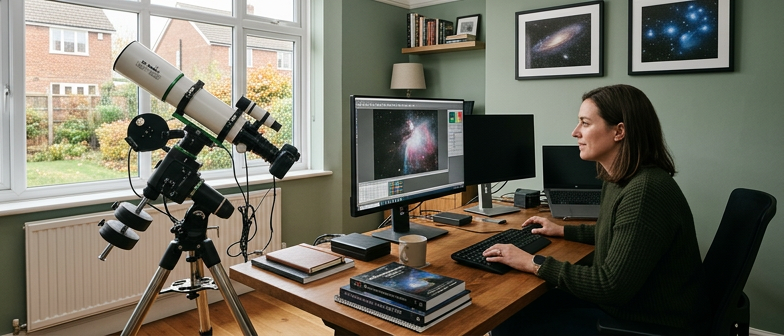
A typical deep sky night begins simply: point the telescope, focus, and choose a manual exposure that keeps stars round and the background not overly bright. Planning software that takes your camera, optics, gain, filters, and sky brightness into account can suggest exposure ranges.
Once a workable combination is found, the main task is to gather many individual “light” frames rather than just one or two long shots. Long sequences allow stacking to pull out faint signal and smooth the noise.
Raw frames often look underwhelming. The background can seem gray or reddish, with only a faint hint of the target. That is expected, because the data are still linear and unenhanced. Before judging them, it is worth checking that they are truly raw and not secretly processed in‑camera, since later steps such as background measurement and calibration depend on untouched data.
A simple way to think about the pieces involved is to consider what each type of frame contributes:
| Frame type | Main purpose | Typical capture conditions |
|---|---|---|
| Light | Record actual celestial signal plus noise | Target centered, normal focus and tracking |
| Dark | Capture sensor patterns and hot pixels | Same exposure, gain, and temperature as lights |
| Flat | Map vignetting and dust shadows | Even field illumination, same optical path |
| Bias or offset | Characterize very short‑exposure noise floor | Shortest available exposure, same gain |
These supporting frames do not add new sky information, but they allow the main images to be cleaned in a controlled, repeatable way.
Calibration, Stacking, and the Reveal
Deep sky projects rely on calibration frames to clean up the lights. Dark frames, taken with the same exposure time, gain, resolution, optics, and temperature as the lights, help reduce fixed patterns and hot pixels. Keeping the system physically stable and avoiding focus changes reduces variation between lights and darks.
Once lights and darks are matched, stacking software can combine the series. The program aligns stars in each frame, then averages or otherwise combines the data. Random noise falls while real signal from the target adds up, so structures that were invisible in a single exposure start to appear.
After stacking, curve adjustments and color balance bring out the final view. The key is to stretch the faint details into a visible range without crushing shadows or blowing out bright regions. Tools may also help with gradient removal or color calibration.
Protecting Stars and Nebulae When Software Joins In
Keeping Bright Stars Under Control
When a camera records a bright star next to a faint nebula, the detector can be overwhelmed. Raw frames may show burned‑out star cores, noisy gas clouds, or both. Workflows lean on a few techniques to keep everything balanced instead of simply increasing exposure.
Stacking is often the first shield against problems. Multiple short sub‑exposures are aligned and averaged. Random noise decreases, while true signal from stars and nebulae accumulates. Because the combined image starts cleaner, later contrast and color adjustments can be applied more gradually.
Dark frames help prevent artificial “halos” by subtracting sensor patterns before any strong processing steps. This reduces tiny gradients around bright stars that might otherwise be misinterpreted as real nebulosity.
Teaching Software to Separate Gas and Starlight
For glowing clouds of gas, separation from the surrounding star field is often the key step. Stars are almost point‑like, with sharp, compact profiles. Emission regions are softer and more extended. Many tools exploit this difference to build masks: one that follows stars, and another that follows the nebula.
With a star mask in place, highlights around stellar cores can be tamed using local contrast or dynamic range controls, while the nebula mask receives extra stretching, sharpening, and color work. This targeted approach reduces the risk of turning bright stars into large, flat white blobs when trying to show faint background detail.
Color channels can guide that separation as well. Emission regions lit by intense radiation often appear stronger in certain bands than in others. By balancing broadband RGB data carefully or emphasizing the channels where the gas is most prominent, structures such as pillars and filaments become clearer without forcing the whole image into unnatural tones.
For observers working with modest equipment, these techniques are a way to make the most of limited photons. Thoughtful choices in optics, exposure, calibration, stacking, and masking turn a noisy gray frame into a structured, interpretable view, linking small backyard systems to the same basic principles used in large observatories.
Q&A
-
How does modern telescope imaging technology differ from traditional visual observing at the eyepiece?
Modern telescope imaging technology replaces the human eye with sensitive electronic sensors that collect photons over long periods, then digitize and store the signal for later processing. This allows stacking, calibration, and advanced image enhancement, dramatically increasing depth, dynamic range, and measurable detail compared with brief, real‑time visual impressions. -
What are the key principles of light collection basics that matter for deep sky observation?
Light collection basics center on aperture size, optical efficiency, and how evenly the light is delivered to the sensor. A larger effective collecting area and well‑controlled optical path concentrate more photons per pixel, improving signal relative to noise and allowing fainter galaxies, nebulae, and outer structures of bright objects to be recorded consistently. -
Which image processing methods most effectively reveal faint deep sky features without exaggerating artifacts?
Effective image processing methods combine careful calibration, noise reduction applied on linear data, and moderate nonlinear stretching guided by masks. Local contrast control, deconvolution, and color calibration are introduced gradually, with star‑nebula separation and multiscale adjustments used to protect small structures while avoiding artificial ringing, halos, or oversaturated regions around bright objects. -
How does observatory equipment design influence space science visualization quality and reliability?
Observatory equipment design shapes stability, thermal control, and repeatability, all crucial for high‑quality space science visualization. Rigid mounts, low‑expansion materials, controlled airflow, and modular instrument interfaces reduce flexure and focus drift. Thoughtful cable routing and environmental monitoring support consistent, long‑term datasets suitable for quantitative analysis and reproducible imaging projects. -
What amateur astronomy tools can help non‑experts contribute useful deep sky data to space science projects?
Amateur astronomy tools such as cooled CMOS cameras, robotic mounts, plate‑solving software, and standardized calibration workflows let non‑experts collect scientifically valuable measurements. Cloud‑based processing, scripted acquisition, and citizen‑science platforms help amateurs share calibrated images, light curves, and astrometric data that complement professional surveys and long‑term monitoring campaigns.